Sunday, 18 June 2023

Maratha & Chitpavans

Marathas seem to have a lot of variation in their Andronovo and AASI ranges. Perhaps this is a confirmation of the fact the modern Maratha caste assimilated many Kunbi tillers and Dhangars (Holkars). Maratha castes like the Jadhavs (maternal lineage of Chattrapati Shivaji) claimed descent from the old Kshatriya families like the Devagiri Yadavs, makes sense to assume they'd be different to Kunbis. Chitpavans seem identical to most Dravidian Brahmins. This means their stereotypical lighter skin and colored eyes are not a consequence of some exotic admixture but just a result of sexual selection plus endogamy bolstered by cousin marriages. 


We can somewhat confirm the MT-10 sample isn't a mislabeled Brahmin because it doesn't plot next to Brahmins on G25, but to an assortment of North Indian like castes. All Brahmins cluster next to Brahmins. 


Wednesday, 19 April 2023

Ancient genomes from northern China suggest links between subsistence changes and human migration


Abstract

Northern China harbored the world’s earliest complex societies based on millet farming, in two major centers in the Yellow (YR) and West Liao (WLR) River basins. Until now, their genetic histories have remained largely unknown. Here we present 55 ancient genomes dating to 7500-1700 BP from the YR, WLR, and Amur River (AR) regions. Contrary to the genetic stability in the AR, the YR and WLR genetic profiles substantially changed over time. The YR populations show a monotonic increase over time in their genetic affinity with present-day southern Chinese and Southeast Asians. In the WLR, intensification of farming in the Late Neolithic is correlated with increased YR affinity while the inclusion of a pastoral economy in the Bronze Age was correlated with increased AR affinity. Our results suggest a link between changes in subsistence strategy and human migration, and fuel the debate about archaeolinguistic signatures of past human migration.


Saturday, 15 April 2023

On Haplogroup Q

Native American Branch


Q-M3 > Q-M848 are the main native american lineages. TMRCA of Q-M3 is 12600 YBP. However a parallel but upstream lineage Q-M1107 TMRCA 15400 YBP is also found in natives. Both Q-M3 and Q-M1107 come from Q-L54 ultimately. Q-M3 comes from Q-M930 but the latter has some European exclusive lineages too. Q-M3 is also known as Q1a2a1a1. 


Indian Branches

1. Q-L275 or Q3 is found in India. Oldest sample with it is an Afanasievo Altai one C2034 ~ 2500 BCE from Kumar et al 2022. Subclade is Q-NGQ1. Then a few ones from Xinjiang, one Chemurchek and the Sappali Tepe outlier that is Indian like in admixture I7493 context dated 2000-1600 BCE is also Q3 (Q-Z19128 / TMRCA 3699 BCE). Then we get 2 people from Loebanr who carry it (I13228, I5400) dated to approx 1000-800 BCE. They are on the a clade downstream from Q-Z19128. Abusanteer 7 from Kumar et al or C4272 also carries Q-Y2265 (the sample is dated to 700-200 BCE). One of the historical Saidu Sharif samples I7718 also carries Q-L275, subclade is Q-Z19128 same as the Sappali Tepe outlier. Finally, Roopkund 53 or I6939 also carries Q-L275 > Q-L245. 

Now, looking at the modern data for Q-L275 at Y-full and FT-DNA. Q-Z19128 is only shared between Turkics and South Asians. Probably a non-WSH/Afanasievo derived line? Otoh, Q-NGQ1 > Q-M378 is found in Europeans as well as South-Central Asians. It's also found in one Afanasievo sample, and one Xinjiang EBA steppe sample. The Abusanteer 7 clade Q-Y2265 is found in a shit load of South Asians and one Turk, one Chinese Tajik on Y-full.

On Y-full, Q-Y2200 2500ybp formed, TMRCA 1500 ybp seems to be a uniquely Balto-Slavic clade, found in some Israeli Yiddish speakers too. This is the only European exclusive branch of Q-L275 I've found there.

2. The main East Asian Q-clade is Q-Y647 (Q > Q-L472 > Q-Y570 > Q-M120 > Q-Y647) and it has a TMRCA of 4000 BCE. 


relevant papers

Thursday, 12 January 2023

New insights into the Epipaleolithic of western Central Asia: The Tutkaulian complex

ABSTRACT 

Bracketed by the Zagros, Hindukush, Altai, and Himalaya Mountains, Central Asia was a likely a migration route for early people moving into North and East Asia. Because of its central geographic setting, the area also channeled cultural and technological influences and exchange between adjoining regions in early prehistory. In this paper we analyze techno-typological characteristics of stone tool assemblages assigned to Early and Late Epipaleolithic industries from two key archaeological sites in Tajikistan – Tutkaul and Obi-Kiik. We compare –these industries with preceding Upper Paleolithic assemblages from the same region, as well as with cultural entities from the Levant and Zagros which share technological traits. Our study reveals key similarities, suggesting that the Tutkaul and Obi-Kiik techno-complexes belong to a single Epipaleolithic culture – which we refer to as the Tutkaulian – split into a three-stage developmental sequence. We argue that the Tutkaulian, defined by bladelet-based primary reduction and an abundance of geometric microliths, with a chronological progression from trapeze-rectangle to lunate forms, has its origins in the local Upper Paleolithic culture (Kulbulakian) emerging through repeated episodes of cultural exchange with earlier or synchronous Levantine and Zagros industries.


https://www.sciencedirect.com/science/article/abs/pii/S104061821830199X 

Wednesday, 11 January 2023

F3 allele sharing to Sidon MBA

Uploading: 781447 of 781447 bytes uploaded.


F3 allele sharing of modern and ancient Levantine populations with Bronze Age Levant (Sidon MBA - likely same genetics as the Ancient Israelites). Higher the f3 estimate, the genetically "closer" the population. F3 is far superior than FST for small population sizes and for taking highly drifted groups like Samaritans into account.

You can see Iron Age & Hellenistic-Roman Era Lebanese are closest. What's surprising is how close Cypriots are. Let's see how much Sidon MBA ancestry they have.


Target: Cypriot
Distance: 1.1574% / 0.01157384
52.2Levant_Sidon_MBA
34.0GRC_Minoan_Lassithi
13.8Yamnaya_RUS_Samara


52.2% Sidon MBA! Now it makes a bit of sense. Phoenican ancestry likely? Lines up with their haplogroups as well, and with recorded history (Cyprus is right off Lebanon in a map). I don't think this is an overfitted model either, the f3 stats are quite clear on it. 

Sunday, 8 January 2023

Indian simulations.

How would Indians look like without one of their three major ancestral components: Iranian Farmer, Steppe MLBA and AASI?

Let's see by artifically subtracting them one by one from the G25 coordinates Bhumihar Brahmin from North India.

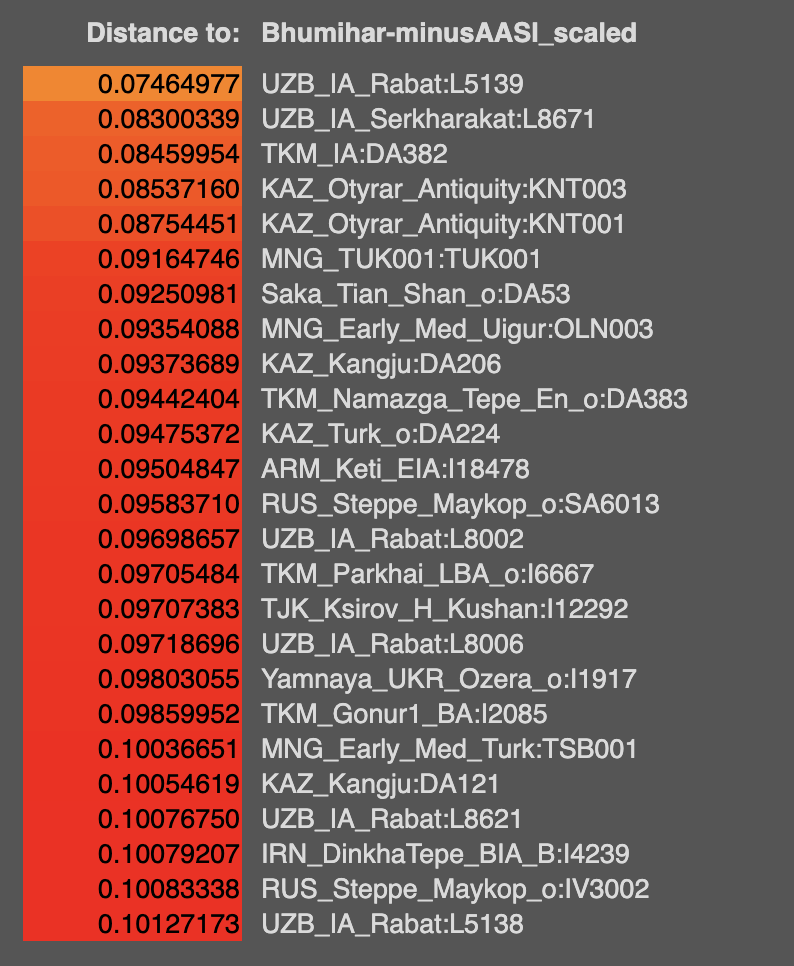
1) Bhumihar minus AASI


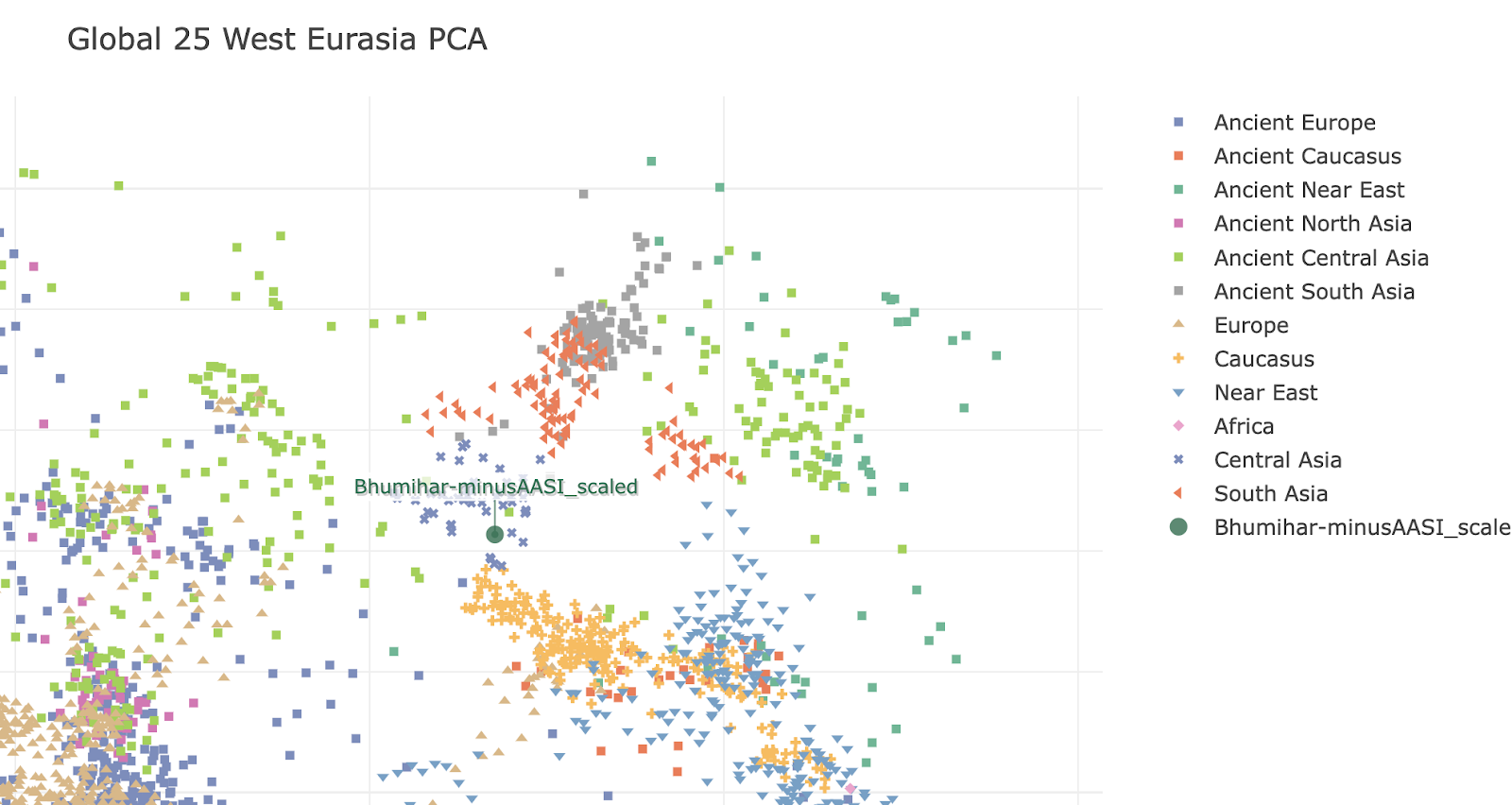
0% AASI makes the Bhumihar closest to Pamiri Tajiks and some North East Caucasians who have high proportions of Iranian Farmer plus Steppe ancestry. Here's how the DNA looks like.


PCA position. 

Lies outside the South Asian cluster and instead clusters with Pamiri Tajiks, close to North East Caucasians.

2) Bhumihar without Iranian Farmer


This individual is not close to any modern Indian and lies outside the Indian cline completely. 

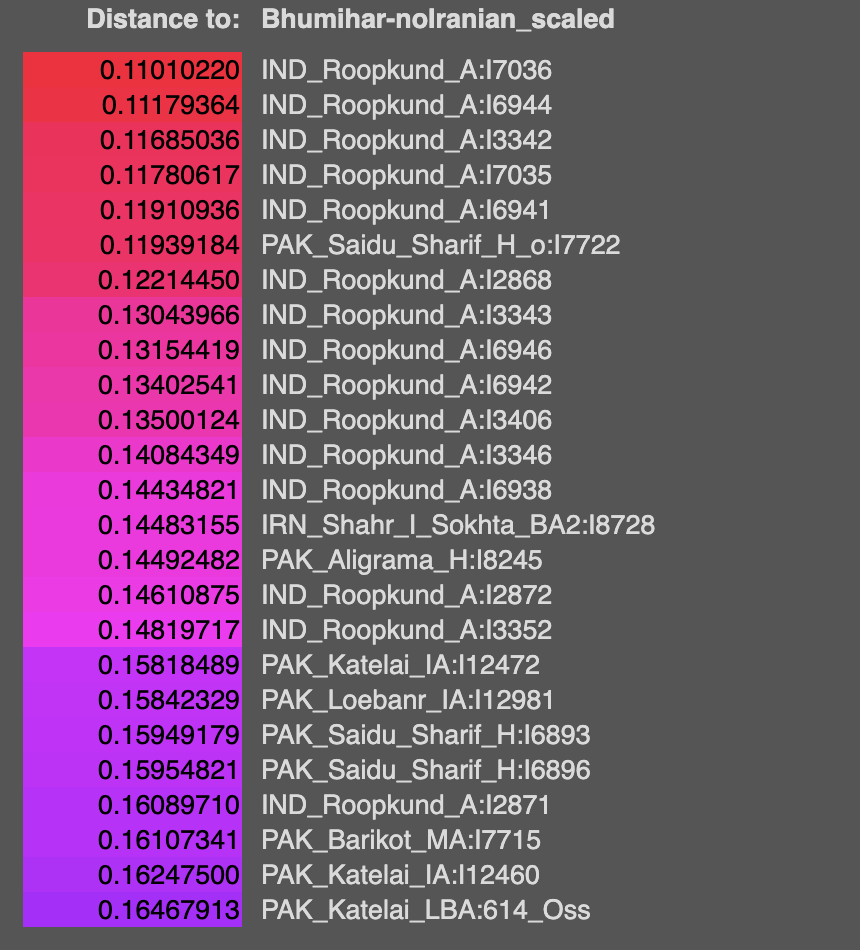
3) Bhumihar without Steppe MLBA


Wow, this individual literally still lies on the Indian cline even after artifically subtracting 26% Steppe ancestry from his genome. In fact, he now resembles a normal South Indian mid caste. This is further confirmed by the fact that the Bhumihar-NoSteppe simulation is the only one that still lies in the modern Indian cline on a South Asian PCA.


Distances to Ancients.


We get the same results. The no-Steppe simulation is the only one that has low enough genetic distances to some kind of Ancient Indian populations, namely the IVC and Swat samples. The no-AASI simulation is closest to Iron Age Tajikistan and Kazakasthan. The no-Iranian sim is not close to anything.


Friday, 6 January 2023

Y-DNA of the Khatri

 Y-DNA chart of Punjabi Khatris based on 60 samples from 4 studies plus about 4 private samples.

Studies used:

1) Underhill et al 2010 (15 samples)

2) Sahoo et al 2006 (7 samples)

3) GenomeAsia100K Project 2019 (5 samples)

4) Mascarenhas et al 2015 (29 samples)

Thursday, 5 January 2023

Indian DNA in Roman Era Levant

 A Genetic History of the Near East from an aDNA Time Course Sampling Eight Points in the Past 4,000 Years


The Iron and Classical Ages in the Near East were marked by population expansions carrying cultural transformations that shaped human history, but the genetic impact of these events on the people who lived through them is little-known. Here, we sequenced the whole genomes of 19 individuals who each lived during one of four time periods between 800 BCE and 200 CE in Beirut on the Eastern Mediterranean coast at the center of the ancient world’s great civilizations. We combined these data with published data to traverse eight archaeological periods and observed any genetic changes as they arose. During the Iron Age (∼1000 BCE), people with Anatolian and South-East European ancestry admixed with people in the Near East. The region was then conquered by the Persians (539 BCE), who facilitated movement exemplified in Beirut by an ancient family with Egyptian-Lebanese admixed members. But the genetic impact at a population level does not appear until the time of Alexander the Great (beginning 330 BCE), when a fusion of Asian and Near Easterner ancestry can be seen, paralleling the cultural fusion that appears in the archaeological records from this period. The Romans then conquered the region (31 BCE) but had little genetic impact over their 600 years of rule. Finally, during the Ottoman rule (beginning 1516 CE), Caucasus-related ancestry penetrated the Near East. Thus, in the past 4,000 years, three limited admixture events detectably impacted the population, complementing the historical records of this culturally complex region dominated by the elite with genetic insights from the general population.


Hellenistic and Early Roman Period Levantines carried about 7-8% Iron Age South Asian ancestry. This is confirmed by the haplogroups found in these Roman era Levantines. 

 The relationship of ancient Lebanon with Central and South Asia also manifests in the presence of haplogroup L1a1-M27 among the modern Lebanese Y chromosome lineages (Figure S10). Haplogroup L1a1-M27 is common today in Central and South Asia but rare elsewhere.  We tested46 (see Supplemental Methods) the coalescence of the five L1a1-M27 Lebanese chromosomes and found that they all derived from a man who lived around 450 BCE–50 CE, a time interval overlapping with the Hellenistic period

The resuslts are further confirmed by haplotype segment sharing.

We then analyzed haplotype segments shared between the ancient Lebanese and modern populations in set 2 by using ChromoPainter44 on 2.5 million imputed SNPs and found that two Hellenistic individuals (SFI-5 and SFI-12) and one early Roman individual (SFI-11) had excess haplotype sharing with Central and South Asians (Figures 2E and S9), thus confirming the qpAdm results.

So some Indian men carrying L1a1-M27 migrated to the Levant around the Hellenistic Period, the time when and their haplogroup exist till date in the modern Lebanese, along with trace Indian admix.

Wednesday, 28 December 2022

The Swat Protohistoric samples

In South Asian genetics, we suffer from a paucity of ancient DNA to study. We have about 100 samples from Pakistan, Gandhara to be precise. These samples range from the Late-Bronze Age to the Medieval Historic period. Then, we have about two dozen samples from Roopkund Lake that are generally from antiquity but going up to the middle ages. This is all we have to work with. So let's analyze the profile of the Swat Protohistoric samples first.

One thing I would like to discuss before we begin is the presence of BMAC/Oxus/Turanian Bronze Age DNA in these Swat samples. Many people take G25 models too seriously and believe there is upwards of 30-45% Oxus ancestry in the Gandhara samples. I think this is entirely wrong, as formal tools such as qpAdm reject BMAC decisively or give very little amounts of it (2-5%)

To illustrate my point, take a look at a G25 profile of the samples with BMAC + Sintashta.


30% BMAC in Loebanr_IA and 25% BMAC in Katelai_IA! Keep this ridiculously high number in mind. Now, let us see what qpAdm says. 

Katelai_IA (click for the file run)

  1. weights
  2. # A tibble: 3 × 5
  3. target left weight se z
  4. <chr> <chr> <dbl> <dbl> <dbl>
  5. 1 Pakistan_Katelai_IA Russia_MLBA_Sintashta 0.163 0.0197 8.29
  6. 2 Pakistan_Katelai_IA Indus_Gonur 0.816 0.0395 20.7
  7. 3 Pakistan_Katelai_IA Uzbekistan_Dzharkutan_BA_1 0.0211 0.0459 0.459

2.1% BMAC/Oxus! down from the ridiculous 25% given before. 

Now, let's look at  Loebanr_IA

  1. $weights
  2. # A tibble: 3 × 5
  3. target left weight se z
  4. <chr> <chr> <dbl> <dbl> <dbl>
  5. 1 Pakistan_Loebanr_IA Russia_MLBA_Sintashta 0.176 0.0194 9.03
  6. 2 Pakistan_Loebanr_IA Indus_Gonur 0.832 0.0404 20.6
  7. 3 Pakistan_Loebanr_IA Uzbekistan_Dzharkutan_BA_1 -0.00746 0.0463 -0.161

Pure BMAC is literally rejected as a source. Loebanr_IA gets modeled purely as Indus_Gonur + Sintashta.  This is doubt enough to make us deeply suspicious of G25 runs for South Asians that use pure BMAC as a source. What's likely happening here is an overfit + affinity to BMAC based on higher proportions of ANF/CHG ancestry that are missing from the Indus Valley samples we currently have. Increased sampling of the IVC might fix this. The only way Indians get any BMAC is indirectly, via Steppe sources mixed with BMAC like Dashti Kozy or later historic ones like Kangju or the Iron Age Yaz sample TKM_IA (Takhirbai_IA). This indirect BMAC ancestry peaks in North-Western populations at perhaps 15%, nothing more. G25 however is not able to differentiate IVC from BMAC at the moment, so all calculators using BMAC are not very useful at the moment.

This is indeed the conclusion that Narasimhan et al 2019 came to also. 

Therefore, here is a model of the Swat Protohistoric samples without BMAC/Oxus as a source.


Kumsay here serves as proxy of the kind of Central Asian ancestry the Andronovo Pastoralists might have picked up on there way to the subcontinent. Using the same model, here is what we get for modern North-West Indian and some Pakistani populations.


Modern samples have more Steppe than most of the ancient ones, but the devil lies in the detail and in population structure. The modern samples are fairly homogeneous (barring the Punjabi_Lahore set which is a mix of all kinds of Pakistani castes). Are the ancient sample sets also homogeneous? Let's see. 

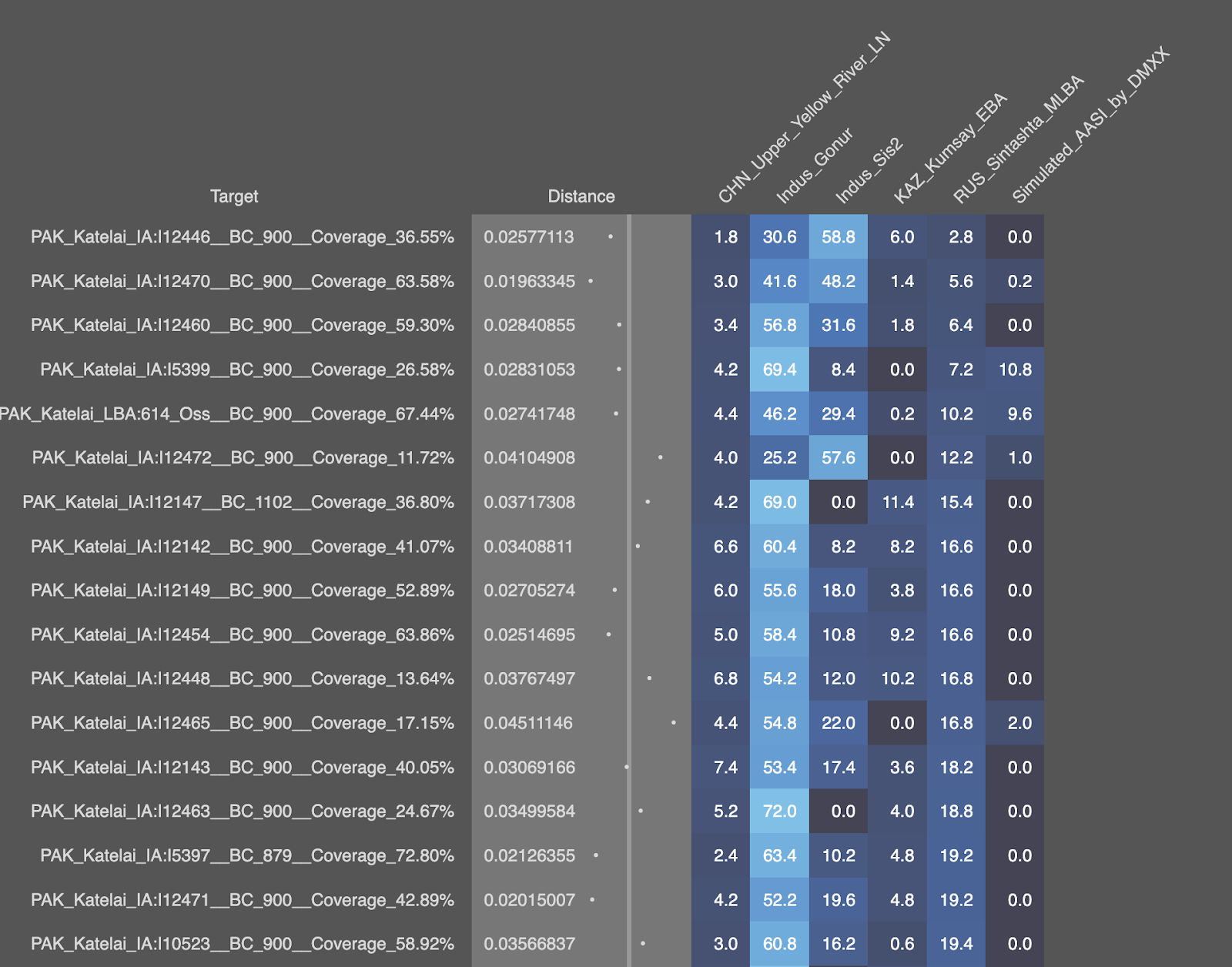
Indeed, what we find is that the Iron Age samples are not homogeneous, which makes sense. The modern samples are from stratified and endogamous Indian caste groups that have avoided intermarrying each other for millenia, the ancient ones are a graveyard dump of all sorts of people. We see that some of the Loebanr_IA samples are as low as 5% Steppe (I12981, I12134) while some of the Katelai_IA are as low as 2% Steppe (I12446, I12470, I12460) while some are as high as 28% Steppe (I12141). The Udegram_IA, Saidu_Sharif_H and Butkara_IA ones are far more homogeneous. Saidu Sharif_H has one outlier that is like 33-35% Steppe and one outlier that is like <5% Steppe.

Here are all the runs posted. 


For Katelai_IA, will split it in 2 screenshots.


Similarly for Loebanr_IA due to large number of samples.


Even after accounting for most of the outliers, we can see that in general, the Iron/Bronze Age and Historic samples are about 5-8% lower Steppe_MLBA than modern North Westerners. Perhaps this points to different waves of migration and a different wave of Indo-Aryans giving rise to modern North Westerners (with differences amongst themselves too). This can be confirmed by Y-DNA to a regard, where tribes such as Khatris get 65% R1a-Z93 with most of it being the Indian L-657 while the Swat Protohistoric samples are maxxed out in J2, E1b, L-M20 with barely any R-Z93s. Hence, clearly different paternal lineages gave rise to lot of these tribes. Those lineages must've different in their exact autosomal profile too, even if it was very similar. For more on the Swat haplogroups, see this post of mine

Saturday, 24 December 2022

Genetics of the Kurmi Tiller caste

The Kurmi are a Shudra caste of non-elite tillers and reside mostly in the North Indian states of Uttar Pradesh and Bihar. Something cool I found while studying about this caste was that the first Prime Minister of Mauritius was a Kurmi. The name Kurmi probably comes from a Sanskrit word for tiller.

We have one high quality Kurmi sample (500k snps) and this gives us an opportunity to take a look at their ancestry profile closely. There is a lot of discussion on the ancestry of Brahmins, Kshatriyas, Vaishyas from North India, but not much around North Indian Shudras. So, this will be helpful. 

Using ADMIXTOOLS 2, this is what I get for the lone Kurmi sample (evo_10)


Uttar Pradesh Kurmi

Russia_MLBA_Sintashta: 15.7 ± 2.28%
Indus_Periphery_Gonur: 46.6 ± 3.76%
Onge (AASI proxy): 37.7
 ± 2.41%

p-value: 0.349

This shows us that Shudra castes such as Kurmis have about 15-16% Sintashta-like ancestry, which is similar to how much Sintashta South Indian Brahmins have but have much higher Onge/AASI like ancestry than those South Indian Brahmins. This confirms what Razib Khan had said before, that South India saw higher IVC wave while in North India it was Aryans mixing with much purer AASI which is what gives the unique profile we see here of relatively high steppe plus high onge.

File of the run

https://pastebin.com/Vcw1KMUV


Saturday, 3 December 2022

Long-term genetic stability and a high-altitude East Asian origin for the peoples of the high valleys of the Himalayan arc

Long-term genetic stability and a high-altitude East Asian origin for the peoples of the high valleys of the Himalayan arc


Abstract

The high-altitude transverse valleys [>3,000 m above sea level (masl)] of the Himalayan arc from Arunachal Pradesh to Ladahk were among the last habitable places permanently colonized by prehistoric humans due to the challenges of resource scarcity, cold stress, and hypoxia. The modern populations of these valleys, who share cultural and linguistic affinities with peoples found today on the Tibetan plateau, are commonly assumed to be the descendants of the earliest inhabitants of the Himalayan arc. However, this assumption has been challenged by archaeological and osteological evidence suggesting that these valleys may have been originally populated from areas other than the Tibetan plateau, including those at low elevation. To investigate the peopling and early population history of this dynamic high-altitude contact zone, we sequenced the genomes (0.04×–7.25×, mean 2.16×) and mitochondrial genomes (20.8×–1,311.0×, mean 482.1×) of eight individuals dating to three periods with distinct material culture in the Annapurna Conservation Area (ACA) of Nepal, spanning 3,150–1,250 y before present (yBP). We demonstrate that the region is characterized by long-term stability of the population genetic make-up despite marked changes in material culture. The ancient genomes, uniparental haplotypes, and high-altitude adaptive alleles suggest a high-altitude East Asian origin for prehistoric Himalayan populations.


Interestingly, all reads from our ACA individuals match the derived allele for the nonsynonymous EGLN1 SNP rs186996510 (SI Appendix, Table S2), including the oldest Chokhopani sample (C1). This derived allele, c.12G > C (p.Asp4Glu), is reported in high frequency in Tibetans (0.64–0.85) (2237), but is rare in low-altitude East Asians (0.03 in 1KG phase 3 East Asians) and virtually absent outside East Asia. Functional studies have implicated this allele as playing a role in oxygen homeostasis under hypoxic conditions (3739). In contrast, reads supporting derived alleles at the EPAS1 SNPs were found in two of the three later Samdzong individuals (S35 and S41), but not in the earlier Chokhopani (C1) or Mebrak (M63) individuals. 


Tuesday, 29 November 2022

Genomic insights into population history and biological adaptation in Oceania


Abstract

The Pacific region is of major importance for addressing questions regarding human dispersals, interactions with archaic hominins and natural selection processes1. However, the demographic and adaptive history of Oceanian populations remains largely uncharacterized. Here we report high-coverage genomes of 317 individuals from 20 populations from the Pacific region. We find that the ancestors of Papuan-related (‘Near Oceanian’) groups underwent a strong bottleneck before the settlement of the region, and separated around 20,000–40,000 years ago. We infer that the East Asian ancestors of Pacific populations may have diverged from Taiwanese Indigenous peoples before the Neolithic expansion, which is thought to have started from Taiwan around 5,000 years ago2,3,4. Additionally, this dispersal was not followed by an immediate, single admixture event with Near Oceanian populations, but involved recurrent episodes of genetic interactions. Our analyses reveal marked differences in the proportion and nature of Denisovan heritage among Pacific groups, suggesting that independent interbreeding with highly structured archaic populations occurred. Furthermore, whereas introgression of Neanderthal genetic information facilitated the adaptation of modern humans related to multiple phenotypes (for example, metabolism, pigmentation and neuronal development), Denisovan introgression was primarily beneficial for immune-related functions. Finally, we report evidence of selective sweeps and polygenic adaptation associated with pathogen exposure and lipid metabolism in the Pacific region, increasing our understanding of the mechanisms of biological adaptation to island


https://www.nature.com/articles/s41586-021-03236-5

Genetic History of the South East Asian Negritos

 1.  Discerning the Origins of the Negritos, First Sundaland People: Deep Divergence and Archaic Admixture

Abstract

Human presence in Southeast Asia dates back to at least 40,000 years ago, when the current islands formed a continental shelf called Sundaland. In the Philippine Islands, Peninsular Malaysia, and Andaman Islands, there exist indigenous groups collectively called Negritos whose ancestry can be traced to the "First Sundaland People." To understand the relationship between these Negrito groups and their demographic histories, we generated genome-wide single nucleotide polymorphism data in the Philippine Negritos and compared them with existing data from other populations. Phylogenetic tree analyses show that Negritos are basal to other East and Southeast Asians, and that they diverged from West Eurasians at least 38,000 years ago. We also found relatively high traces of Denisovan admixture in the Philippine Negritos, but not in the Malaysian and Andamanese groups, suggesting independent introgression and/or parallel losses involving Denisovan introgressed regions. Shared genetic loci between all three Negrito groups could be related to skin pigmentation, height, facial morphology and malarial resistance. These results show the unique status of Negrito groups as descended from the First Sundaland People.

2.  Sequence analyses of Malaysian Indigenous communities reveal historical admixture between Hoabinhian hunter-gatherers and Neolithic farmers

Abstract

Southeast Asia comprises 11 countries that span mainland Asia across to numerous islands that stretch from the Andaman Sea to the South China Sea and Indian Ocean. This region harbors an impressive diversity of history, culture, religion and biology. Indigenous people of Malaysia display substantial phenotypic, linguistic, and anthropological diversity. Despite this remarkable diversity which has been documented for centuries, the genetic history and structure of indigenous Malaysians remain under-studied. To have a better understanding about the genetic history of these people, especially Malaysian Negritos, we sequenced whole genomes of 15 individuals belonging to five indigenous groups from Peninsular Malaysia and one from North Borneo to high coverage (30X). Our results demonstrate that indigenous populations of Malaysia are genetically close to East Asian populations. We show that present-day Malaysian Negritos can be modeled as an admixture of ancient Hoabinhian hunter-gatherers and Neolithic farmers. We observe gene flow from South Asian populations into the Malaysian indigenous groups, but not into Dusun of North Borneo. Our study proposes that Malaysian indigenous people originated from at least three distinct ancestral populations related to the Hoabinhian hunter-gatherers, Neolithic farmers and Austronesian speakers.

3. Unveiling the Genetic History of the Maniq, a Primary Hunter-Gatherer Society 

Abstract

The Maniq of southern Thailand is one of the last remaining practicing hunter-gatherer communities in the world. However, our knowledge on their genetic origins and demographic history is still largely limited. We present here the genotype data covering ∼2.3 million single nucleotide polymorphisms of 11 unrelated Maniq individuals. Our analyses reveal the Maniq to be closely related to the Semang populations of Malaysia (Malay Negritos), who altogether carry an Andamanese-related ancestry linked to the ancient Hòabìnhian hunter-gatherers of Mainland Southeast Asia (MSEA). Moreover, the Maniq possess ∼35% East Asian-related ancestry, likely brought about by recent admixture with surrounding agriculturist communities in the region. In addition, the Maniq exhibit one of the highest levels of genetic differentiation found among living human populations, indicative of their small population size and historical practice of endogamy. Similar to other hunter-gatherer populations of MSEA, we also find the Maniq to possess low levels of Neanderthal ancestry and undetectable levels of Denisovan ancestry. Altogether, we reveal the Maniq to be a Semang group that experienced intense genetic drift and exhibits signs of ancient Hòabìnhian ancestry.

Friday, 25 November 2022

Untangling Neolithic and Bronze Age mitochondrial lineages in South Asia

Abstract

Two key moments shaped the extant South Asian gene pool within the last 10 thousand years (ka): the Neolithic period, with the advent of agriculture and the rise of the Harappan/Indus Valley Civilisation; and Late Bronze Age events that witnessed the abrupt fall of the Harappan Civilisation and the arrival of Indo-European speakers. This study focuses on the phylogeographic patterns of mitochondrial haplogroups H2 and H13 in the Indian Subcontinent and incorporates evidence from recently released ancient genomes from Central and South Asia. It found signals of Neolithic arrivals from Iran and later movements in the Bronze Age from Central Asia that derived ultimately from the Steppe. This study shows how a detailed mtDNA phylogeographic approach, combining both modern and ancient variation, can provide evidence of population movements, even in a scenario of strong male bias such as in the case of the Bronze Age Steppe dispersals.

Complete mitogenomes document substantial genetic contribution from the Eurasian Steppe into northern Pakistani Indo-Iranian speakers


Abstract

To elucidate whether Bronze Age population dispersals from the Eurasian Steppe to South Asia contributed to the gene pool of Indo-Iranian-speaking groups, we analyzed 19,568 mitochondrial DNA (mtDNA) sequences from northern Pakistani and surrounding populations, including 213 newly generated mitochondrial genomes (mitogenomes) from Iranian and Dardic groups, both speakers from the ancient Indo-Iranian branch in northern Pakistan. Our results showed that 23% of mtDNA lineages with west Eurasian origin arose in situ in northern Pakistan since ~5000 years ago (kya), a time depth very close to the documented Indo-European dispersals into South Asia during the Bronze Age. Together with ancient mitogenomes from western Eurasia since the Neolithic, we identified five haplogroups (~8.4% of maternal gene pool) with roots in the Steppe region and subbranches arising (age ~5-2 kya old) in northern Pakistan as genetic legacies of Indo-Iranian speakers. Some of these haplogroups, such as W3a1b that have been found in the ancient samples from the late Bronze Age to the Iron Age period individuals of Swat Valley northern Pakistan, even have sub-lineages (age ~4 kya old) in the southern subcontinent, consistent with the southward spread of Indo-Iranian languages. By showing that substantial genetic components of Indo-Iranian speakers in northern Pakistan can be traced to Bronze Age in the Steppe region, our study suggests a demographic link with the spread of Indo-Iranian languages, and further highlights the corridor role of northern Pakistan in the southward dispersal of Indo-Iranian-speaking groups.

Wednesday, 23 November 2022

Japan-Korea paper dump

 1)  Ancient genomics reveals tripartite origins of Japanese populations

Abstract

Prehistoric Japan underwent rapid transformations in the past 3000 years, first from foraging to wet rice farming and then to state formation. A long-standing hypothesis posits that mainland Japanese populations derive dual ancestry from indigenous Jomon hunter-gatherer-fishers and succeeding Yayoi farmers. However, the genomic impact of agricultural migration and subsequent sociocultural changes remains unclear. We report 12 ancient Japanese genomes from pre- and postfarming periods. Our analysis finds that the Jomon maintained a small effective population size of ~1000 over several millennia, with a deep divergence from continental populations dated to 20,000 to 15,000 years ago, a period that saw the insularization of Japan through rising sea levels. Rice cultivation was introduced by people with Northeast Asian ancestry. Unexpectedly, we identify a later influx of East Asian ancestry during the imperial Kofun period. These three ancestral components continue to characterize present-day populations, supporting a tripartite model of Japanese genomic origins.

2)  Human genetics: The dual origin of Three Kingdoms period Koreans

Summary

The genetic history of Koreans remains poorly understood due to a lack of ancient DNA. A new paleo-genomic study shows that population stratification in 4th–5th century South Korean populations was linked to a varied proportion of indigenous Jomon-related ancestry, which does not survive in present-day Koreans. 

3)  Northeastern Asian and Jomon-related genetic structure in the Three Kingdoms period of Gimhae, Korea

Summary

The genetic history of prehistoric and protohistoric Korean populations is not well understood because only a small number of ancient genomes are available. Here, we report the first paleogenomic data from the Korean Three Kingdoms period, a crucial point in the cultural and historic formation of Korea. These data comprise eight shotgun-sequenced genomes from ancient Korea (0.7×–6.1× coverage). They were derived from two archeological sites in Gimhae: the Yuha-ri shell mound and the Daesung-dong tumuli, the latter being the most important funerary complex of the Gaya confederacy. All individuals are from between the 4th and 5th century CE and are best modeled as an admixture between a northern China Bronze Age genetic source and a source of Jomon-related ancestry that shares similarities with the present-day genomes from Japan. The observed substructure and proportion of Jomon-related ancestry suggest the presence of two genetic groups within the population and diversity among the Gaya population. We could not correlate the genomic differences between these two groups with either social status or sex. All the ancient individuals’ genomic profiles, including phenotypically relevant SNPs associated with hair and eye color, facial morphology, and myopia, imply strong genetic and phenotypic continuity with modern Koreans for the last 1,700 years.


    Maratha & Chitpavans

    Marathas seem to have a lot of variation in their Andronovo and AASI ranges. Perhaps this is a confirmation of the fact the modern Maratha c...