Showing posts with label yamnaya. Show all posts

Thursday, 20 October 2022

The genomic ancestry of the Scandinavian Battle Axe Culture people and their relation to the broader Corded Ware horizon

 https://royalsocietypublishing.org/doi/10.1098/rspb.2019.1528


We generated and analysed genome sequence shotgun data from 11 individuals originating in northeastern Europe datedto 3300–1660 cal BCE (electronic supplementary material,table S1). Five individuals were excavated from CWC contexts:two from Obłaczkowo, Poland, one from Karlova, Estonia,and two from the CWC-related BAC burial Bergsgraven in Linköping, Sweden. The six additional individuals werefrom other archaeological contexts in Sweden: five from megalithic burial structures primarily associated with Funnel BeakerCulture (FBC) (two from Rössberga in Västergötland and threefrom Öllsjö in Scania) and one from a Pitted Ware Culture(PWC) context (Ajvide on Gotland). Radiocarbon dating showed that the three individuals from the Öllsjö megalithic tomb derived from later burials, where oll007 (2860–2500 calBCE) overlaps with the time interval of the BAC, and oll009and oll010 (1930–1650 cal BCE) fall within the Scandinavian Late Neolithic and Early Bronze Age (table 1; electronic supplementary material, table S1 and figure S2). Genome-wide sequence coverages range from 0.1 to 3.2×, and the sequence data for all individuals exhibit characteristic properties ofancient DNA: short fragment size and cytosine deamination at the ends of fragments (e.g. [24]) (table 1; electronic sup-plementary material, figure S5). Estimates of mitochondrialcontamination [25] were low, less than 2% for all 11 individuals, as was the estimated nuclear contamination on theX-chromosome in males [26,27] (less than 1.2%) (table 1; electronic supplementary material, table S3). Five individuals were genetically determined to be males, and six were females,based on the fraction of sequence fragments mapping to thedifferent sex chromosomes [28] (table 1)


The other individuals who were contemporary with BAC but had unclear cultural contexts, and who were buried in the Ölljsö megalith constructed many hundred years earlier (oll007), or found as a stray find (Ölsund) [9], show the same genetic profile as individuals from typical BAC contexts in other parts of Sweden
The best fitting two-source model was Funnelbeaker (FBC) + Yamnaya (YAM) (p = 0.86), while YAM + PWC (Pitted Ware Culture) would also fit the data (although trending toward low p-values; p = 0.07). These observations suggest that—to our statistical resolution—a direct PWC contribution to BAC is not needed in a model, but actual PWC admixture might have been small or there may have been indirect PWC contributions through PWC first mixing with FBC [34] who later contributed ancestry to BAC. Notably, using only the CWC population as the single source for BAC was consistent with the data in all cases (p > 0.05, except when using CWC-associated individuals from Latvia, CWC_LV).  The BAC groups fit as a sister group to the CWC-associated group from Estonia (CWC_EE, electronic supplementary material, figure S8) but not as a sister group to the CWC groups from Poland (CWC_PL, figure 3) or Lithuania (CWC_LT, electronic supplementary material) (|Z| > 3), indicating some differences in ancestry between these CWC groups and BAC. 

Funnelbeaker tombs were reused by the Battle Axe Culture.

The Scandinavian Middle Neolithic megalithic tombs are associated with the FBC. However, their reuse, indicated by artefacts common to the BAC and later periods, has been noted [17]. The oll007 individual, buried in the FBC-associated Öllsjö megalithic tomb, but radiocarbon dated to the time period of the BAC, is genetically very similar to individuals from BAC contexts (e.g. Bergsgraven and Viby). Thus, although archaeologically the reuse of megalithic tombs was assumed earlier [17], our study may be the first direct link (using genetics) showing that indeed FBC-associated megalithic tombs were used as burial places also for the people of the BAC. This could possibly also extend to the Danish Single Grave Culture (SGC) [49], as RISE61 [2], a male buried in the Kyndeløse passage grave and with a radiocarbon date overlapping with the BAC/CWC/SGC time period, also displays some steppe ancestry. 


Supplementary information: https://royalsocietypublishing.org/action/downloadSupplement?doi=10.1098%2Frspb.2019.1528&file=rspb20191528supp1.pdf


More here: https://onlinelibrary.wiley.com/doi/10.1002/ajpa.24079


Monday, 17 October 2022

An Indo-Iranian Symbol of Power in the Earliest Steppe Kurgans

 https://www.academia.edu/3836804/An_Indo_Iranian_Symbol_of_Power_in_the_Earliest_Steppe_Kurgans


This burial was apparently near a Srubna (Timber-Grave) settlement too. Here's a description of the Kurgan.

The diameter of kurgan 4 was about 21 meters, and the modern height of the mound is 0.85 m. Central grave 1 was dug into the clay subsoil. The clay taken out of the pit was spread around it in the shape of two platforms. In the center of the northern platform, outside the central grave pit, a secondary accompanying burial was made (Fig. 3) Here a mature female was laid on her back with her knees raised and her head towards the east. Her feet were abundantly powdered by ochre. Her body was covered when the mound was constructed. The principal burial, grave 1, was in a pit measuring 2.8 x 1.7m. It was oriented with its long axis NW-SE. The pit floor was 1.07m beneath the original ground surface. A mature male was laid on his back, originally with his knees half-bent and raised vertically. Later they fell to the right side. The skull was found fallen forward on the chest. The right arm was stretched out along the body; the left was a little bent at the elbow. The body lay across the long axis of the grave, with the head oriented ENE. The facial area of the skull was abundantly painted with red ochre, the pelvis and feet were less painted. A fibrous organic bedding about half a centimeter thick was under the skeleton. The structure of the fibers suggests that the bed was made of either narrow strips of bark fastened together or, more probably, reed mats


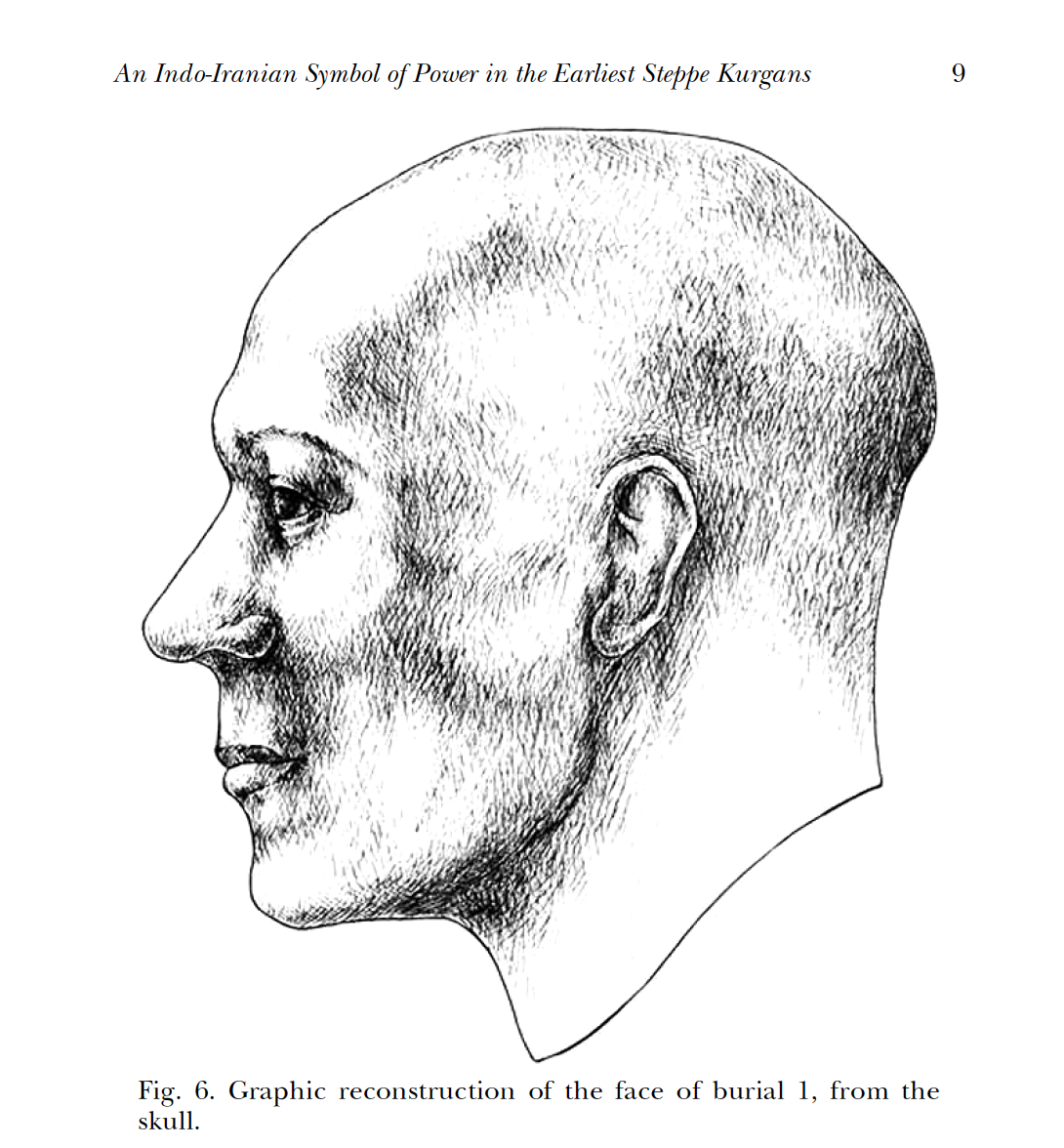
Specialist A. Khokhlov of Samara State Pedagogical University determined that the skeleton was of a male 35-40 years old (Fig. 5). His legs were unusually long, especially the lower legs. His forearms also were long. He stood more than 176cm. tall, which is taller than the average height of modern European men. Detailed examination of the joint surfaces of the skeleton led A. Khohlov to the conclusion that the Kutuluk man was unusually active, particularly in walking and/or running.


Calibration of these samples firmly dates the Kutuluk grave to 3100-2800 BC, with the most probable date between 3000 and 2900 BC. The first half of the 3rd millennium BC corresponds well with the dates of other Late Yamnaya culture complexes. A massive copper object was found in the crook of the left arm of the Kutuluk man. It is 48.7cm long overall and weighs 750gms. The handle part is 12.6cm long. The handle is rectangular with polished edges. Some traces indicate that the handle was wrapped with an organic material, probably a leather strap up to 7mm wide. The butt of the handle is semiovoid in plan and broadened in section, giving it extra weight.


Some characteristics of the Vajra.

 Among the first to describe the vajra as a cudgel-like weapon was L.S. Klein (Klein 1985: 75). The vajra was tetrahedral (RV 4.22.2]. It had a cow skin-strap (RV 1.121.9). It could be ground (RV 1.55.1). But it had one more very important characteristic—it glistened: All the above-mentioned characteristics of the vajra are most detailed and exact. If we summarize them, we get a description of a weapon used to deliver heavy blows, fracturing and splintering bones, like a cudgel. It had a cow-hide strap. The vajra was made of metal and glistened like gold under the sun, so it must have been made of polished copper or bronze. It was tetrahedal, or four-faced, like the diamond-sectioned Kutuluk cudgel-scepter. Among all the weapon types of Bronze Age, over a period of one and a half thousand years, only the Kutuluk find corresponds to the description of the vajra in the RigVeda. Even the leather strap braiding the handle is rather pertinent in this case.

Similar finds by Falk in the OCP copper hoards.

On the territory of Hindustan in the Ganges-Yamuna Doab are found copper hoards of the 2nd millennium BC, the post-Harappan period. They are connected with the Ochre Colored Pottery culture, which occupied a territory sometimes linked with that of the early Indo-Aryans. Falk noted that the copper hoards included so-called bar-celts, which by their shape and size absolutely coincide with Kutuluk cudgel-scepter. “The vast majority measure about half a meter, and weigh about 1.5kg (Hami, Bihar) or 2.2kg (Gungeria). Therefore I propose to interpret these pieces of copper as clubs, used to kill an adversary either by hitting or by being thrown.” (Falk 1993: 200]. Falk considers the bar-celts to be the material expression of the vajra, the divine weapon of Indra (Falk 1993: 201).


Possible prototypes of the Yamna cudgel?


Prototypes for this specific type of weapon have not been found among earlier Early Bronze Age kurgans, but large antler clubs and polished stone mace-heads of various kinds are wellknown weapons of the Eneolithic period (5000-3500 BC) in the Middle Volga region. These might also have been hurled in battle. They provide earlier examples of weapons that functioned in a way similar to the Kutuluk cudgel-scepter


Maratha & Chitpavans

Marathas seem to have a lot of variation in their Andronovo and AASI ranges. Perhaps this is a confirmation of the fact the modern Maratha c...