vritrahan

He slays the foe and wins the spoil who worships Indra and Agni, strong and mighty Heroes, Who rule as Sovereign over ample riches, victorious, showing forth their power in conquest - Rigveda 6.60.1

Showing posts with label south asian. Show all posts

Wednesday, 28 December 2022

The Swat Protohistoric samples

In South Asian genetics, we suffer from a paucity of ancient DNA to study. We have about 100 samples from Pakistan, Gandhara to be precise. These samples range from the Late-Bronze Age to the Medieval Historic period. Then, we have about two dozen samples from Roopkund Lake that are generally from antiquity but going up to the middle ages. This is all we have to work with. So let's analyze the profile of the Swat Protohistoric samples first.

One thing I would like to discuss before we begin is the presence of BMAC/Oxus/Turanian Bronze Age DNA in these Swat samples. Many people take G25 models too seriously and believe there is upwards of 30-45% Oxus ancestry in the Gandhara samples. I think this is entirely wrong, as formal tools such as qpAdm reject BMAC decisively or give very little amounts of it (2-5%)

To illustrate my point, take a look at a G25 profile of the samples with BMAC + Sintashta.


30% BMAC in Loebanr_IA and 25% BMAC in Katelai_IA! Keep this ridiculously high number in mind. Now, let us see what qpAdm says. 

Katelai_IA (click for the file run)

  1. weights
  2. # A tibble: 3 × 5
  3. target left weight se z
  4. <chr> <chr> <dbl> <dbl> <dbl>
  5. 1 Pakistan_Katelai_IA Russia_MLBA_Sintashta 0.163 0.0197 8.29
  6. 2 Pakistan_Katelai_IA Indus_Gonur 0.816 0.0395 20.7
  7. 3 Pakistan_Katelai_IA Uzbekistan_Dzharkutan_BA_1 0.0211 0.0459 0.459

2.1% BMAC/Oxus! down from the ridiculous 25% given before. 

Now, let's look at  Loebanr_IA

  1. $weights
  2. # A tibble: 3 × 5
  3. target left weight se z
  4. <chr> <chr> <dbl> <dbl> <dbl>
  5. 1 Pakistan_Loebanr_IA Russia_MLBA_Sintashta 0.176 0.0194 9.03
  6. 2 Pakistan_Loebanr_IA Indus_Gonur 0.832 0.0404 20.6
  7. 3 Pakistan_Loebanr_IA Uzbekistan_Dzharkutan_BA_1 -0.00746 0.0463 -0.161

Pure BMAC is literally rejected as a source. Loebanr_IA gets modeled purely as Indus_Gonur + Sintashta.  This is doubt enough to make us deeply suspicious of G25 runs for South Asians that use pure BMAC as a source. What's likely happening here is an overfit + affinity to BMAC based on higher proportions of ANF/CHG ancestry that are missing from the Indus Valley samples we currently have. Increased sampling of the IVC might fix this. The only way Indians get any BMAC is indirectly, via Steppe sources mixed with BMAC like Dashti Kozy or later historic ones like Kangju or the Iron Age Yaz sample TKM_IA (Takhirbai_IA). This indirect BMAC ancestry peaks in North-Western populations at perhaps 15%, nothing more. G25 however is not able to differentiate IVC from BMAC at the moment, so all calculators using BMAC are not very useful at the moment.

This is indeed the conclusion that Narasimhan et al 2019 came to also. 

Therefore, here is a model of the Swat Protohistoric samples without BMAC/Oxus as a source.


Kumsay here serves as proxy of the kind of Central Asian ancestry the Andronovo Pastoralists might have picked up on there way to the subcontinent. Using the same model, here is what we get for modern North-West Indian and some Pakistani populations.


Modern samples have more Steppe than most of the ancient ones, but the devil lies in the detail and in population structure. The modern samples are fairly homogeneous (barring the Punjabi_Lahore set which is a mix of all kinds of Pakistani castes). Are the ancient sample sets also homogeneous? Let's see. 

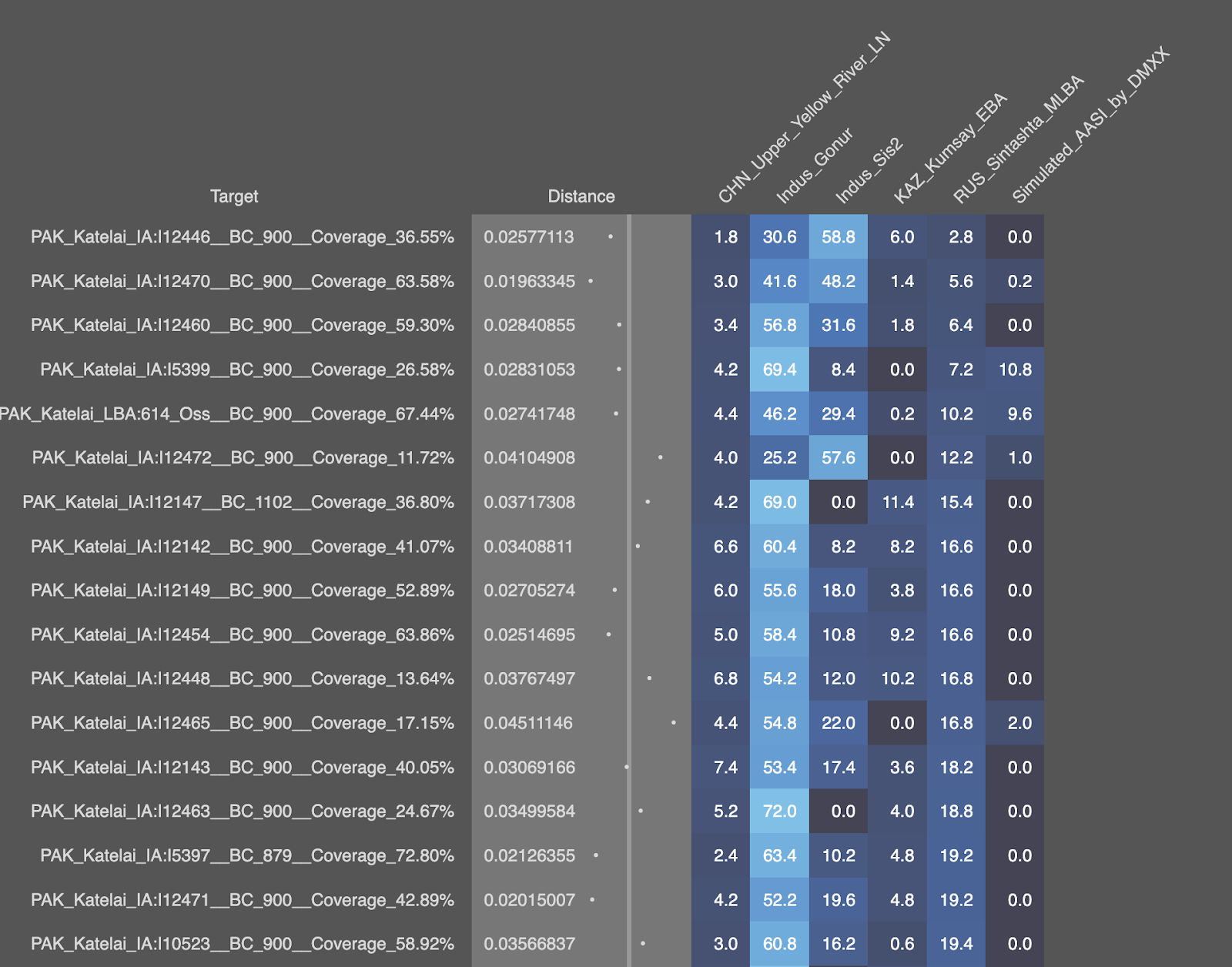
Indeed, what we find is that the Iron Age samples are not homogeneous, which makes sense. The modern samples are from stratified and endogamous Indian caste groups that have avoided intermarrying each other for millenia, the ancient ones are a graveyard dump of all sorts of people. We see that some of the Loebanr_IA samples are as low as 5% Steppe (I12981, I12134) while some of the Katelai_IA are as low as 2% Steppe (I12446, I12470, I12460) while some are as high as 28% Steppe (I12141). The Udegram_IA, Saidu_Sharif_H and Butkara_IA ones are far more homogeneous. Saidu Sharif_H has one outlier that is like 33-35% Steppe and one outlier that is like <5% Steppe.

Here are all the runs posted. 


For Katelai_IA, will split it in 2 screenshots.


Similarly for Loebanr_IA due to large number of samples.


Even after accounting for most of the outliers, we can see that in general, the Iron/Bronze Age and Historic samples are about 5-8% lower Steppe_MLBA than modern North Westerners. Perhaps this points to different waves of migration and a different wave of Indo-Aryans giving rise to modern North Westerners (with differences amongst themselves too). This can be confirmed by Y-DNA to a regard, where tribes such as Khatris get 65% R1a-Z93 with most of it being the Indian L-657 while the Swat Protohistoric samples are maxxed out in J2, E1b, L-M20 with barely any R-Z93s. Hence, clearly different paternal lineages gave rise to lot of these tribes. Those lineages must've different in their exact autosomal profile too, even if it was very similar. For more on the Swat haplogroups, see this post of mine

Haplogroups of the Swat Indians..

at December 28, 2022 1 comment:
Email ThisBlogThis!Share to XShare to FacebookShare to Pinterest
Labels: BMAC, Gandhara Grave Culture, Roopkund, south asian, Swat

Friday, 25 November 2022

Untangling Neolithic and Bronze Age mitochondrial lineages in South Asia

Abstract

Two key moments shaped the extant South Asian gene pool within the last 10 thousand years (ka): the Neolithic period, with the advent of agriculture and the rise of the Harappan/Indus Valley Civilisation; and Late Bronze Age events that witnessed the abrupt fall of the Harappan Civilisation and the arrival of Indo-European speakers. This study focuses on the phylogeographic patterns of mitochondrial haplogroups H2 and H13 in the Indian Subcontinent and incorporates evidence from recently released ancient genomes from Central and South Asia. It found signals of Neolithic arrivals from Iran and later movements in the Bronze Age from Central Asia that derived ultimately from the Steppe. This study shows how a detailed mtDNA phylogeographic approach, combining both modern and ancient variation, can provide evidence of population movements, even in a scenario of strong male bias such as in the case of the Bronze Age Steppe dispersals.

at November 25, 2022 No comments:
Email ThisBlogThis!Share to XShare to FacebookShare to Pinterest
Labels: H13, H2, mtDNA, south asian

Monday, 14 November 2022

Founder lineages in the Iberian Roma mitogenomes recapitulate the Roma diaspora and show the effects of demographic bottlenecks


Abstract

The Roma are the largest ethnic minority in Europe. With a Northwestern Indian origin around ~ 1.5 kya, they travelled throughout West Asia until their arrival in Europe around the eleventh century CE. Their diaspora through Europe is characterized by population bottlenecks and founder events which have contributed to their present day genetic and cultural diversity. In our study, we focus on the effects of founder effects in the mitochondrial DNA (mtDNA) pool of Iberian Roma by producing and analyzing 144 novel whole mtDNA sequences of Iberian Roma. Over 60% of their mtDNA pool is composed by founder lineages of South Asian origin or acquired by gene flow during their diaspora in the Middle East or locally in Europe in Europe. The TMRCA of these lineages predates the historical record of the Roma arrival in Spain. The abundance of founder lineages is in contrast with ~ 0.7% of autochthonous founder lineages present in the non-Roma Iberian population. Within those founder lineages, we found a substantial amount of South Asian M5a1b1a1 haplotypes and high frequencies of West Eurasian founder lineages (U3b1c, J2b1c, J1c1b, J1b3a, H88, among others), which we characterized phylogenetically and put in phylogeographical context. Besides, we found no evidence of genetic substructure of Roma within the Iberian Peninsula. These results show the magnitude of founder effects in the Iberian Roma and further explain the Roma history and genetic diversity from a matrilineal point of view.

https://www.nature.com/articles/s41598-022-23349-9

at November 14, 2022 No comments:
Email ThisBlogThis!Share to XShare to FacebookShare to Pinterest
Labels: founder effect, gypsy, roma, south asian
Older Posts Home
Subscribe to: Posts (Atom)

Maratha & Chitpavans

Marathas seem to have a lot of variation in their Andronovo and AASI ranges. Perhaps this is a confirmation of the fact the modern Maratha c...

  • Genetics of the Kurmi Tiller caste
    The Kurmi are a Shudra caste of non-elite tillers and reside mostly in the North Indian states of Uttar Pradesh and Bihar. Something cool ...
  • The Swat Protohistoric samples
    In South Asian genetics, we suffer from a paucity of ancient DNA to study. We have about 100 samples from Pakistan, Gandhara to be precise. ...
  • The Indo-Iranian cline.
    Below is a custom-PCA that shows us the genetic variation in modern Indo-Iranians. Let us make some observations. The left-right PC1 cline s...

Search This Blog

  • Home

Archive

  • ▼  2023 (8)
    • ▼  June 2023 (1)
      • Maratha & Chitpavans
    • ►  April 2023 (2)
    • ►  January 2023 (5)
  • ►  2022 (31)
    • ►  December 2022 (3)
    • ►  November 2022 (11)
    • ►  October 2022 (11)
    • ►  September 2022 (6)

Labels

  • AASI
  • Abashevo
  • Abusanteer
  • acute illness
  • Aegean
  • africa
  • aligrama
  • amur river
  • andamanese
  • Andronovo
  • Animal style art
  • Archaeology
  • Army
  • Arzhan
  • ashkelon
  • austronesian
  • balanovo
  • bantu
  • Bara style
  • battle axe culture
  • BMAC
  • Bronze Age
  • Bustan
  • campsite
  • cereal
  • Chariots
  • china
  • chokhopani
  • cholesterol
  • Cimmerian
  • Classical Greek
  • copper
  • copper hoard
  • corded ware
  • cudgel
  • cyprus
  • denisovan
  • dinka
  • Dravidian
  • Dzharkutan
  • E1b1b
  • early roman period
  • EGLN1
  • EPAS1
  • Epipaleolithic
  • Eurasian Steppe
  • fatyanovo
  • Fennoscandia
  • Finnish
  • formosa
  • founder effect
  • G25
  • Gandhara Grave Culture
  • Ganga
  • Ghaggar
  • gimhae
  • Greek
  • gypsy
  • H13
  • H2
  • Haplogroup
  • Harappan
  • hellenistic
  • high altitude
  • himalayan
  • Himera
  • hoabinhian
  • homeland
  • Hun
  • I2a
  • Indian
  • Indo-Anatolian
  • Indo-Aryan
  • Indo-European
  • Indo-Iranian
  • indra
  • Indus
  • injury
  • Iran
  • Iranian
  • Iranian Farmer
  • japan
  • jomon
  • KA-5
  • Kalash
  • Khatri
  • khoi san
  • kofun
  • korea
  • Kulbulakian
  • kurgan
  • kurmi
  • Kyrgyz
  • lebanon
  • levant
  • linguistics
  • Loebanr
  • malaysian
  • maniq
  • Mediterranean
  • Mercenaries
  • Mesolithic
  • mtDNA
  • negrito
  • nepal
  • Nganasan
  • north india
  • Northern Black Polished Ware
  • ochre
  • OCP
  • Outlier
  • oxus
  • Painted Grey Ware
  • pakistan
  • Pamiri
  • Parpola
  • Parsi
  • pastoralist
  • Pazyryk
  • PCA
  • Persia
  • phenotype
  • phoenican
  • Pottery
  • Punjabi
  • pygmy
  • Q
  • Q1a
  • Q2
  • qpadm
  • R1a
  • R1a-Z93
  • roma
  • Roopkund
  • Saami
  • Saidu Sharif
  • Sanauli
  • Sappali Tepe
  • Sarmatian
  • scepter
  • Scythian
  • Sejma-Turbino
  • sherpa
  • shudra
  • Siberian
  • Sicily
  • sidon
  • sidon MBA
  • Simulations
  • sino tibetan
  • Sintashta
  • south asian
  • southeast asia
  • SPGT
  • Steppe MLBA
  • stress
  • sub saharan africa
  • subadults
  • substratum
  • sundaland
  • swarthy
  • Swat
  • Taiwan
  • Tajikistan
  • Tajiks
  • Tarim_EMBA1
  • three kingdoms
  • tibeto-burman
  • tiller
  • transcultural
  • Tutkaul
  • Tutkaulian
  • Uralic
  • uttar pradesh
  • Uzbekistan
  • vajra
  • volosovo
  • W3a1b
  • Wakhi
  • west liao river
  • xiaoma caves
  • Xiongnu
  • y-dna
  • yamnaya
  • yayoi
  • yellow river
  • Zoroastrian

Report Abuse

About Me

Aryamsha
View my complete profile
Simple theme. Theme images by wingmar. Powered by Blogger.