Showing posts with label Iran. Show all posts

Wednesday, 5 October 2022

The Indo-Iranian cline.


Below is a custom-PCA that shows us the genetic variation in modern Indo-Iranians.


Let us make some observations. The left-right PC1 cline shows the biggest variation, which is Basal East Eurasian vs. West Eurasian ancestry. To the far left, we have AASI rich tribals such as Birhor, Paniya and Irula, and to the far right, we have Iranian Jews who have no AASI ancestry.


As we head to the right, we see South Indian OBCs and farming castes, as well as some North Indian Chamars, Punjabi Christians, Marathas and Yadavas clustering together. These groups have little Steppe ancestry and are mostly a 50:50 mix of Iranian Farmer:AASI. It is interesting to see Christians from Punjab cluster with South Indian OBCs and Chamars, this would make sense since they might be converts from the lower castes. A note must be made here: it's unlikely the Yadavs here are from North India, as the ones from North India have 15-20% Steppe ancestry, rather they maybe Gollas from the Telugu states. 

The Marathas in the G25 dataset are from Karnataka so only have 5% Steppe ancestry. It's quite possible that 96 Kulin Maratha have a different genetic profile. Moving further to the right, we see some Reddys, Velamas and a lot of Punjabi Lahore samples. Now, the Reddys are a dominant land-owning caste of the Telugu-speaking lands and while traditionally considered as Shudra, they were warriors who ruled a kingdom

In fact, for any non-Indian reading this post, it must be ascertained that Shudra did not really represent a "low-caste" historically, but only the caste of farmers and pastoralists, who occassionally would also become warriors. The original Vaishya caste had this function in Vedic times: that of pastoralists and farmers, hence why they were literally called the vish, or the people. This function got transfered to the Shudras long before Christ was born, which is why the Manusmriti talks about Shudra Kings ruling in different parts of India. 

Moving on, what's interesting is the diversity in the Punjabi_Lahore cluster. A lot of the people in it cluster with South Indians, and a lot are on the other extreme, clustering with Punjabis Jats, Kamboj and Khatris. This tells us that the researchers who sampled this did not take caste into account, so Lahori Punjabis from Pakistan who are low caste got included in a label with Lahori Punjabis from Pakistan who are Jats, Gujjars etc. 

Further right, we see a cluster that has most Brahmins, a few Keralites, many Nepalese and a couple of Rajputs. This is the generic "UC" or Upper Caste cluster. By the way, ignore the Uttar Pradesh Brahmin outliers and Rajput outliers from this PCA. They are shifted towards Mongoloid Tibeto-Burmans, and this maybe because they're from Uttarakhand where the natives are mixed with Tibeto-Burmans, or it maybe a case of mislabelling the samples. The non-outlier Rajput from Rajasthan clusters with UP Brahmins. Regardless, we see that Bengali Brahmins, Tamil Brahmins, Keralite Brahmins, Rajputs, some Keralite middle castes such as Vaniya and Christian and many Nepali Brahmins cluster together. Many samples from Punjabi_Lahore can also be found here. 
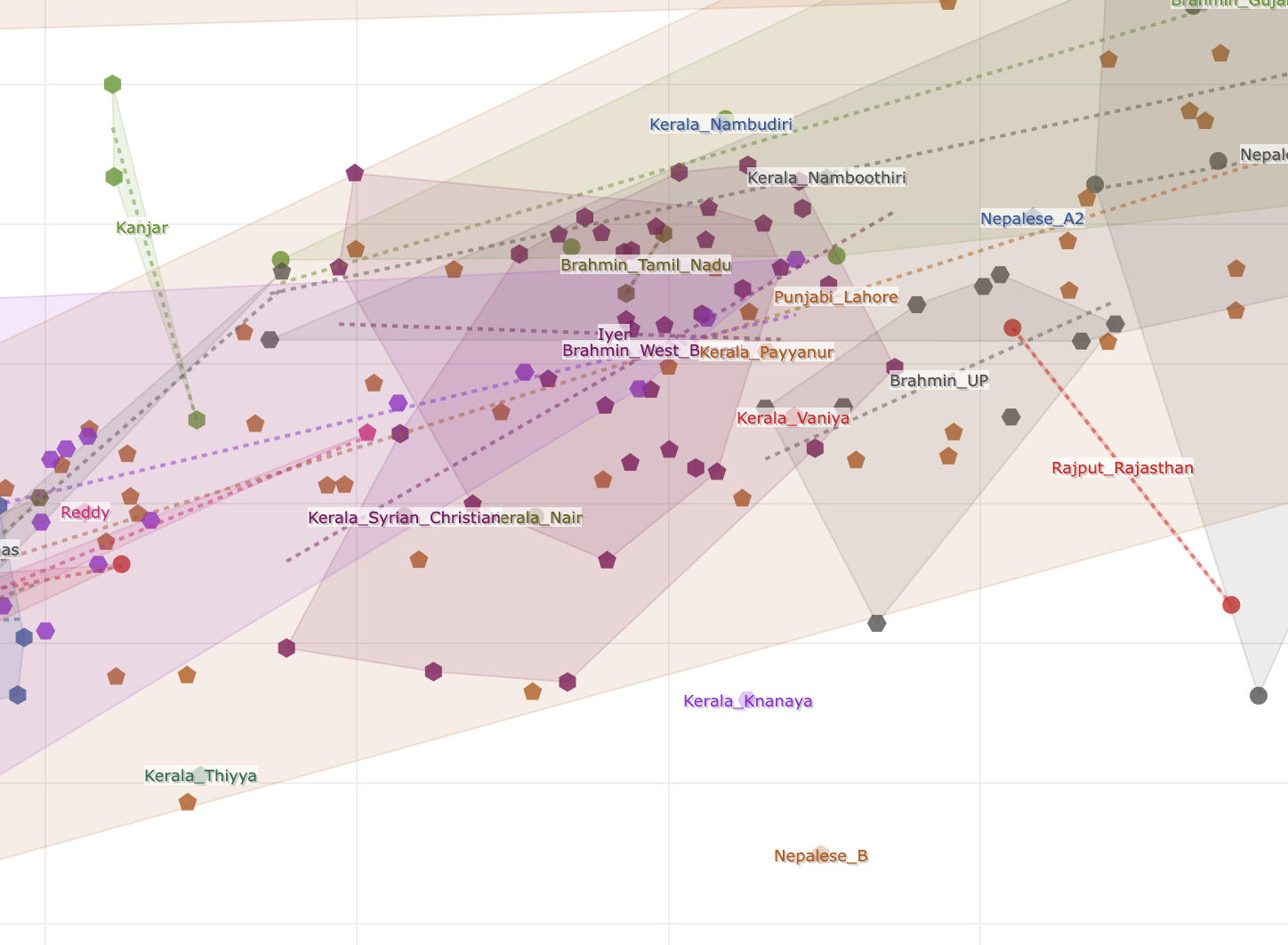

Further right, we see the North-West Brahmin cluster, which is more Steppe/West Eurasian shifted than the generic UC cluster, and has Brahmins from Jammu, Himachal, Kashmir and Gujarat, clustering along with some Punjabi Hindus and NepaleseA (likely Nepali Brahmins).


To the right of this, we get the North West Indo-Pakistani cluster, which contains the most Steppe and Eurasian shifted groups in the subcontinent. Notice how the Rors and Kalash lie a little distinct from this cluster too. The Kalash do not have that much Steppe ancestry (25%) but they do have a lot of Siberian/Turanian ancestry from Bronze Age groups such as Aigryzhal_BA, and actually the Kalash are shifted towards them on the PCA.  This becomes more clear when we see a 3D PCA (the one posted here is 2D unfortunately). 

The main North-West subcontinental tribes such as Sindhis, Khatris, Jatt Sikhs, Jat Hindus, Kamboj and Pakistani Pashtuns cluster together. We can notice how most of the Jat_Hindus cluster have an overlapping cluster with the Rors, indicating many have similar ancestry; however, one of the Hindu Jats is an outlier and clusters with the less Steppe, more AASI shifted Northern Upper castes. This might indicate variation in Jat Hindus, but we might just have too little samples.

Yusufzai and Uthmankhel are Pashtuns from Pakistan, who are shifted to the Iranic cluster but still visibly in range of the NW Indo-Aryan one, thus indicating they have overlapping ancestry from both groups. Also, one can see me in this cluster too, plotted next to the Khatri:K56 sample. This is typical of my own ancestry as a NW Indo-Aryan (55:30:10:5, Indus:Steppe:AASI:BMAC). 


Now begins the Iranic side of Indo-Iranian, the other branch.  First, we come to the Eastern Iranic cluster. The Baloch are split up in 2, with BalochB must more Indo-Aryan shifted while BalochA cluster with the Brahui and one lone southward shifted Tajik. Notice the Brahui, a Dravidian speaking group from Pakistan that has ancestry very typical of Balochi Iranic speakers, perhaps a relic population from the Indus Valley? 

Tajiks are notably northern shifted, as they carry the highest Steppe MLBA ancestry in South-Central Asia, followed closely by Hindu Jats and Rors. Yaghnobi Tajiks, who still speak an Eastern Iranic tongue, have almost no AASI ancestry and hence are visibly separated from the rest. Tajiks from Hisor and Ayni generally have the highest East Asian ancestry in Tajikistan (upto 15%) and the lowest Steppe MLBA (30%). 

Finally, we come to the Western Iranian cluster, that contains Parsis, Lors, Zoroastrians, Persians and Kurds. Note how Parsis from Pakistan and India cluster with Western Iranians, this makes sense as they are 75% West Iranian, 25% Indo-Aryan in DNA. One will also notice how Iranians from Bandari are the closest to Parsis, this also makes sense as they have the highest Indian ancestry in Iran. Bandari in Iranian literally means "from a port" and these are Iranians from the Gulf who obviously had trade contacts with India and Africa (which is also why they carry around 3% Bantu ancestry). By the way, Bandar in Hindi would be 'Bandhdvar', so one can now see the etymology clearly, meaning 'closed door' 


Tuesday, 27 September 2022

An Iranian from 1800 BCE

While scourging through the Narasimhan supple, I found a sample that caught my eye. It clustered on a PCA with modern Iranians and on G25 distances, it had the lowest distances to modern Iranians; however, it was from the post-BMAC site of Sappali Tepe in Uzbekistan and dated to ~1800 BCE cal. 

The supplementary describes it as such.

BMAC_o2 (n=1): This individual has a significantly elevated proportion of ancestry related to

Central_Steppe_MLBA. We call this individual by the BMAC_o2 analysis label and the

Sappali_Tepe_BA_o split label.

• UZ-ST-010, Sappali Tepe (ST) 1975, 6, Grave 02-05 (I7493): Context date of 2000-1600

BCE. Genetically male.


Distance to: UZB_Sappali_Tepe_BA_o

0.03315719 Iranian_Zoroastrian
0.03528786 Iranian_Fars
0.04027134 Iranian_Persian_Shiraz

0.04254455 Azerbaijani_Dagestan
0.04405072 Ezid
0.04435116 Iranian_Mazandarani
0.04586352 Iranian_Lor

On a PCA, Sappali Tepe clusters with other Iranians as well, shifted a bit to the extreme end of the West Iranian Steppe % The rest of the Sappali Tepe site is regular post-BMAC and accordingly clusters with other BMAC (Gonur1) and post BMAC (Bustan BA) sites. So it's obvious this outlier has BMAC + Steppe ancestry. Not that out of the ordinary, right? Even TKM_IA has this mixture.

Target: UZB_Sappali_Tepe_BA_o:I7493
Distance: 4.9056% / 0.04905551
65.2 UZB_Sappali_Tepe_BA
34.8 RUS_Sintashta_MLBA

Poor distance, but where it gets interesting is when you add West Iranian farmer ancestry.  

Target: UZB_Sappali_Tepe_BA_o:I7493
Distance: 3.0157% / 0.03015733
48.2 IRN_Seh_Gabi_C
33.2 RUS_Sintashta_MLBA
18.6 UZB_Sappali_Tepe_BA

This is great, the distance improves a lot. This must mean this individual is a mix of West Iranian type farmers + early East Iranian (TKM_IA) type ancestry. Now, interestingly enough, this must mirror the actual process by which modern West Iranians came to be. Steppe pastoralists mix with Turan_BA (BMAC) type people and form a hybrid 50:50 ish population in the region surrounding modern Tajikistan. This population eventually comes down to the Iranian plateau and mixes with the native Elamite farmers to form modern West Iranians. 

So, let's model it with TKM_IA too, but first add in Indus Valley. 

Target: UZB_Sappali_Tepe_BA_o:I7493
Distance: 2.3048% / 0.02304809
57.2 IRN_Seh_Gabi_C
32.8 RUS_Sintashta_MLBA
10.0 IRN_Shahr_I_Sokhta_BA2

Modern Iranians likely received an additional wave of Levant_C or Anatolia_C that mixed with their Sehi_Gabi type pop, so might as well as try it with that too.

Target: UZB_Sappali_Tepe_BA_o
Distance: 2.1811% / 0.02181055
52.2 TKM_IA
26.6 IRN_Seh_Gabi_C
12.4 Levant_ISR_C
8.8 Indus(Sis2+Gonur)

Yep, way better fits. TKM_IA likely also absorbs nearby WSHG/ANE type ancestry.

Can we replicate this on qpAdm? Let's try. 

Uzbekistan_SappaliTepe_BA_o
Turkmenistan_IA.SG 49.2% ± 9.4
Iran_C_SehGabi 19.8% ± 9.5
Israel_C 20.1% ± 5.6
Indus 10.9% ± 7.3
p-value:  0.300

(Outgroups: Mbuti, EEHG, WEHG (Iron Gates), WSHG, ESHG, Han, Tianyuan, TurkeyN, IranN, Levant PPN, Iberomaurusian/Natufian (optional), CHG, MA1 (optional), Kostenki14 (optional))

This is pretty close to our G25 results. This would mean Sappali Tepe has around ~25% Sintashta ancestry, thus being a perfect fit to model modern Iranians with (who have quite a bit lower Sintashta).
By the way, I tried Anatolia_C and Rus_Maykop_Nosovko as sources too. Former gives quite decent fits on qpAdm and works equally well as a source, but drops TKM_IA to 40% ish. Latter is a poor source, but I decided to try it anyways as some outliers in Bronze Age Turan carry Caucasus ancestry (like the Dzharkutan outliers from Uzbekistan which are Caucasus + Steppe). 

I also tried out other IranN rich profiles such as Sarazm, Geokysur, Parkhai, Namazga as well. They give much poorer fits on G25 and qpAdm. Anyway, let's just do a Dstats run to see if there is indeed allele sharing b/w the two, and to what extent.

result:  Chimp.REF Uzbekistan_SappaliTepe_BA_o Anatolia_C   Israel_C     -0.0235    -4.133     -    7424   7781 153314 

Significant negative Z score, so it looks like Anatolia_C is actually preferred as the Chalcolithic source over Israel_C.  G25 shows the same, the fit improves when we use Anatolia_C. 

Regardless of the exact Chalco source, let's try and model Modern Iranians with the Sappali outlier.

TargetDistance
IRN_Seh_Gabi_C
IRN_Shahr_I_Sokhta_BA2
Levant_ISR_C
MNG_Slab_Grave_EIA_1
UZB_Sappali_Tepe_BA_o
Yoruba
Iranian_Bandari0.02025044
26.620.80.80.048.83.0
Iranian_Fars0.01639102
27.20.87.02.262.80.0
Parsi_India0.01486118
10.829.213.40.845.80.0
Parsi_Pakistan0.01436086
9.627.412.80.849.40.0
Iranian_Lor0.01120472
35.80.010.81.252.20.0
Iranian_Mazandarani0.01877939
44.83.40.00.051.80.0
Iranian_Persian_Shiraz0.01724956
29.03.69.42.655.00.4
Iranian_Zoroastrian0.01704363
22.40.06.60.071.00.0
Average0.01626760
25.810.77.60.954.60.4


Very good fits. If Sappali is around 24-27% ish Steppe, then this gives Iranian Zoroastrians around 18-19% Steppe, which sounds just about right. So this individual from 1800 BCE Uzbekistan is indeed quite close to a modern West Iranian. 

His haplogroup is Q1b2, which is an India specific branch of Q1 (found in the Swat Valley Loebanr samples) and this kinda gives more evidence for the 10-11% Indus Valley ancestry in him. 

This individual is remarkably similar to another outlier from 1500 BCE Uzbekistan, who I discussed in my substack here. However, this outlier clusters with modern Indo-Aryans and contains the 3 way Steppe + Indus + Onge admix that characterizes modern Indians. The Sappali Tepe outlier contains the 3 way mix that characterizes modern Iranians: Steppe + BMAC + Iranian chalcolithic farmer. 

Now, we cannot be possibly sure what language this outlier spoke, but my bet is it was likely some form of early Iranian, thereby meaning the genepool that characterizes modern Indians and Iranians had already formed in Central Asia by 1600-1800 BCE.


Friday, 23 September 2022

The genetic legacy of Zoroastrianism in Iran and India


Zoroastrianism is one of the oldest extant religions in the world, originating in Persia (present-day Iran) during the second millennium BCE. Historical records indicate that migrants from Persia brought Zoroastrianism to India, but there is debate over the timing of these migrations. Here we present novel genome-wide autosomal, Y-chromosome and mitochondrial data from Iranian and Indian Zoroastrians and neighbouring modern-day Indian and Iranian populations to conduct the first genome-wide genetic analysis in these groups. Using powerful haplotype-based techniques, we show that Zoroastrians in Iran and India show increased genetic homogeneity relative to other sampled groups in their respective countries, consistent with their current practices of endogamy. Despite this, we show that Indian Zoroastrians (Parsis) intermixed with local groups sometime after their arrival in India, dating this mixture to 690-1390 CE and providing strong evidence that the migrating group was largely comprised of Zoroastrian males. By exploiting the rich information in DNA from ancient human remains, we also highlight admixture in the ancestors of Iranian Zoroastrians dated to 570 BCE-746 CE, older than admixture seen in any other sampled Iranian group, consistent with a long-standing isolation of Zoroastrians from outside groups. Finally, we report genomic regions showing signatures of positive selection in present-day Zoroastrians that might correlate to the prevalence of particular diseases amongst these communities.


https://www.biorxiv.org/content/10.1101/128272v1 


Analysis of mtDNA and NRY variation using data from the Human Origins array showed that the modal NRY haplogroup in all Iranians and Parsis was J, with maximum frequency observed among the Parsis (freq=0.67; Figure 3a, Table S4). This is consistent with previous NRY haplogroup frequencies observed in Iranian Zoroastrian and non-Zoroastrian groups68. In particular, 8 of the 12 Iranian Zoroastrians from the city of Yazd belonged to NRY haplogroup J. 


We infer the most probable Iranian lay Zoroastrian contribution to the lay Parsis Y-chromosomes to be 96% (median = 86%, mean = 82%, 95% CI = 41% to 99%), whereas the most probable Iranian lay Zoroastrian contribution to Parsis mtDNA is 8% (Figure 3c; median = 26%, mean = 32%, 95% CI = 1% to 88%).  These data are consistent with the majority of Parsi priests being patrilineal descendants of two male founders in the relatively recent past. 


 Consistent with this, we infer the autosomal, sex-averaged contribution to be 61-76% using a variety of modern and ancient Iranian surrogate groups (Figure 2, Figure S7, Tables S9-S11). This supports Zoroastrianism being brought from Iran to India by a group of males, and/or that gene-flow into the Parsi community from the neighbouring Indian population was mainly female-mediated.  


This study mostly confirms what we've known. Parsis are 3/4 Iranian and 1/4 Indian, most of the Zoroastrian migrants were men so mtDNA from India is much higher. Interesting to note is that Iranian Zoroastrians do not really have any higher frequency of haplogroup R either. 

It's Indian Parsis with higher R. 


Maratha & Chitpavans

Marathas seem to have a lot of variation in their Andronovo and AASI ranges. Perhaps this is a confirmation of the fact the modern Maratha c...