Sunday, 9 October 2022

The Fatyanovo were swarthy & not lactose tolerant

 https://www.science.org/doi/10.1126/sciadv.abd6535


The presented genome-wide data are derived from 3 Stone Age HGs (WeRuHG; 10,800 to 4250 cal BCE, BER001, KAR001, PES001) and 26 Bronze Age Fatyanovo Culture farmers from western Russia (Fatyanovo; 2900 to 2050 cal BCE) and 1 Corded Ware Culture individual from Estonia (EstCWC; 2850 to 2500 cal BCE)


In the case of radiocarbon dating, it is possible that fish from rivers and lakes consumed by Stone Age fisher-hunter-gatherers may cause a notable reservoir effect. This means that the radiocarbon dates obtained from the human bones and teeth can be hundreds but not thousands of years older than the actual time these people lived (33). Unfortunately, we do not yet have data to estimate the size of the reservoir effect for each specific case. Then, we turned to the Bronze Age Fatyanovo Culture individuals and determined that they carry maternal (subclades of mtDNA hg U5, U4, U2e, H, T, W, J, K, I, and N1a) and paternal (chrY hg R1a-M417) lineages (Table 1, fig. S1, and tables S2 to S4) that have also been found in CWC individuals elsewhere in Europe (14161827). In all individuals for which the chrY hg could be determined with sufficient depth (n = 6), it is R1a2-Z93. 

The Fatyanovo are the most likely candidates for pre-Proto-Indo-Iranians, representing the earliest stage Pre-Proto-IIr splitting up from what would be Proto-Balto-Slavic. 


We estimated the time of admixture for Yamnaya and EF populations to form the Fatyanovo Culture population using DATES (37) as 13 ± 2 generations for Yamnaya Samara + Globular Amphora and 19 ± 5 generations for Yamnaya Samara + Trypillia. If a generation time of 25 years and the average calibrated date of the Fatyanovo individuals (~2600 cal BCE) are used, this equates to the admixture happening ~3100 to 2900 BCE

The confidence intervals (CIs) were extremely wide with Trypillia, but the chrX data showed 40 to 53% Globular Amphora ancestry in Fatyanovo, in contrast with the 32 to 36% estimated using autosomal data. The sex-biased admixture is also supported by the presence of mtDNA hg N1a in two Fatyanovo individuals—an hg frequent in Linear Pottery Culture (LBK) EFs but not found in Yamnaya individuals so far 

The Fatyanovo were formed as a result of the process of Yamnaya male invaders taking European farmer women as wives, resultant genome being 2/3 Yamnaya and 1/3 EEF. The chrX data is based on a horribly low 45k snps so I will take it with a grain of salt, but the Y-DNA makes it somewhat clear still.


From the phenotype prediction results, we see that only 4% of Fatyanovo samples had blonde/dark blonde hair, while 96% had dark hair and 80% had brown eyes. 60% of the samples had an intermediate skin tone, and the remaining 40% had a combination of mixed skin tone, unpredictable intermediate and just straight up dark skin. Lactase persistence was only 17%, clearly showing that it had already undergone selection from Steppe EMBA times. A gene for high serum cholesterol was 83% but drops to barely 13% by the Estonian Middle Ages, showing strong negative selection for serum cholesterol possibly.

Outgroups used in the study:  Mota, Ust-Ishim, Kostenki14, GoyetQ116, Vestonice16, MA1, AfontovaGora3, ElMiron, Villabruna, WHG, EHG, CHG, Iran_N, Natufian, Levant_N, and Anatolia_N


Wednesday, 5 October 2022

The diverse genetic origins of a Classical period Greek army


https://www.pnas.org/doi/10.1073/pnas.2205272119


Here, we analyze genome-wide data from 33 individuals associated with the Battles of Himera and from Himera’s civilian population, as well as 21 individuals from two nearby settlements associated with the indigenous Sicani culture of Sicily, to provide insight into the genetic ancestry of Sicily’s inhabitants in the first millennium BCE and to provide additional data points for evaluating the role of ancient conflict in population interactions in the ancient Mediterranean.


Using qpAdm, this group (Sicily_IA, new data) can be modeled as an admixture of four sources that distantly contributed to the genetic composition of Europeans (P = 0.179): 
Northwestern Anatolian Neolithic farmers (Turkey_Barcin_N; 76.4 ± 1.2%), WHGs (6.4 ± 1.0%), early farmers from Iran (Iran_GanjDareh_N; 6.3 ± 1.5%), and Early Bronze Age (EBA) Steppe herders associated with the Yamnaya cultural complex (Russia_Samara_EBA_Yamnaya; 10.9 ± 1.6%), which indicates an increase of Iranian-related admixture compared with the preceding LBA Sicily group, which can be best modeled without that component. One line of evidence for some local genetic continuity is the almost exclusive presence of Y-chromosomal haplogroup G-Z1903 and its derivates among the males.


Most Himerans associated with the battles can be found clustering on the PCA closely with individuals from the Greece_LBA, consistent with a major contribution of individuals of primarily Greek ancestry in the Himeran forces and substantial genetic continuity between the LBA period in Greece and fifth-century-BCE Greek colonies in Sicily.  Seven of the 16 soldiers of the 480 BCE battle (Sicily_Himera_480BCE_1) and all 5 of the soldiers of the 409 BCE battle (Sicily_Himera_409BCE) are part of this main genetic cluster. Using the qpWave/qpAdm framework, we can model each of the soldiers in these two groups as deriving their ancestry either 100% from a group related to Greece_LBA or from an admixture between a Sicilian LBA or IA source and an Aegean-related source 


One irritating thing about this unsupervised ADMIXTURE run is they label the Euro HG component as WHG and not EHG. This will obviously have funny results when trying to find non-local ancestry, especially from Northeastern Europe or the Steppes, like Baltic_IA showing up as 50% "WHG"

Looks like the non-outlier Himerian soldiers can be modelled as a mix of Aegean_BA + Sicily_LBA/IA, somewhat bolstering the idea that these Himerians were descendants of Greek colonists mixed with the local Sicilians.

Two individuals (I10943/W0396 and I10949/W0403; Sicily_Himera_480BCE_3) fall with modern northeastern European groups and eastern Baltic populations of the first millennium BCE and can be modeled using exclusively BA individuals from Lithuania as a proxy source (P = 0.129). 

 One low-coverage individual, I17870/W0336, falls intermediate between Sicily_Himera_480BCE_2 and Sicily_Himera_480BCE_3 on both PCA and with respect to the main ancestry clusters inferred from ADMIXTURE. 

Two (I10944/W0461 and I10947/W1774; Sicily_Himera_480BCE_4) fall with individuals from IA nomadic contexts in the Eurasian Steppe. In qpAdm, their ancestry is consistent, with around 85–89% deriving from IA Central steppe nomads and 11–15% from an Aegean-like source, an admixture that plausibly could have taken place among the genetically diverse populations of the Steppe. Their mitochondrial DNA (mtDNA) haplogroups suggest east Eurasian genetic roots: A6a, found so far only in modern-day China (7071), and N1a1a1a, restricted to Russia, Kazakhstan, and Mongolia

Finally, one outlier (I10951/W0653; Sicily_Himera_480BCE_5) falls with modern Caucasus populations and intermediate to ancient Steppe and Caucasus individuals on the PCA and carries the highest proportion of the CHG component in ADMIXTURE (Fig. 2). A single one-way model with a group closely related to Armenia_MBA as the source fit the data (P = 0.293). Similarly, the second low-coverage individual, I17872/W0428, falls closest to populations from the Caucasus on the PCA .

Now, for the outliers.. Won't be surprised if I10944 and I10947 were Sarmatians, they have the typical East Eurasian mtDNA plus slight East Asian DNA (10-15%) in amounts typical of Sarmatians and Cimmerians.


All the soldiers who fall outside the Aegean genetic cluster are interred in mass graves Nos. 1–4 (SI Appendix, Figs. S1–S3), whereas all individuals from mass graves Nos. 5–7 (SI Appendix, Figs. S4–S6) fall within this cluster, a statistically significant difference (P = 0.0028 by a χ2 test with one degree of freedom; Fig. 3). This result mirrors strontium isotope evidence showing more nonlocals interred in mass grave.  Mass graves Nos. 1–4 and Nos. 5–7 also are spatially segregated and differ in size, with mass graves Nos. 1–4 comprising significantly more interments. 

Furthermore, individuals in mass graves Nos. 5 and 6 include grave goods, unlike the other mass graves from 480 BCE (32). The fact that these individuals also fall within the Aegean genetic cluster suggests a link between Aegean ancestry and prestige, as perceived by the individuals responsible for burying the fallen soldiers.

Individuals with “foreign” ancestry, all of whom also are identified as nonlocal on the basis of isotopic evidence (Fig. 3 and Dataset S2), were interred in larger mass graves Nos. 1–4, and individuals with genetic affinities to other Greek populations were interred in the smaller mass graves Nos. 5–7

It looks like the local soldiers, who were of Aegean descent, were given more prestigious burials than the non-local ones. 


The Indo-Iranian cline.


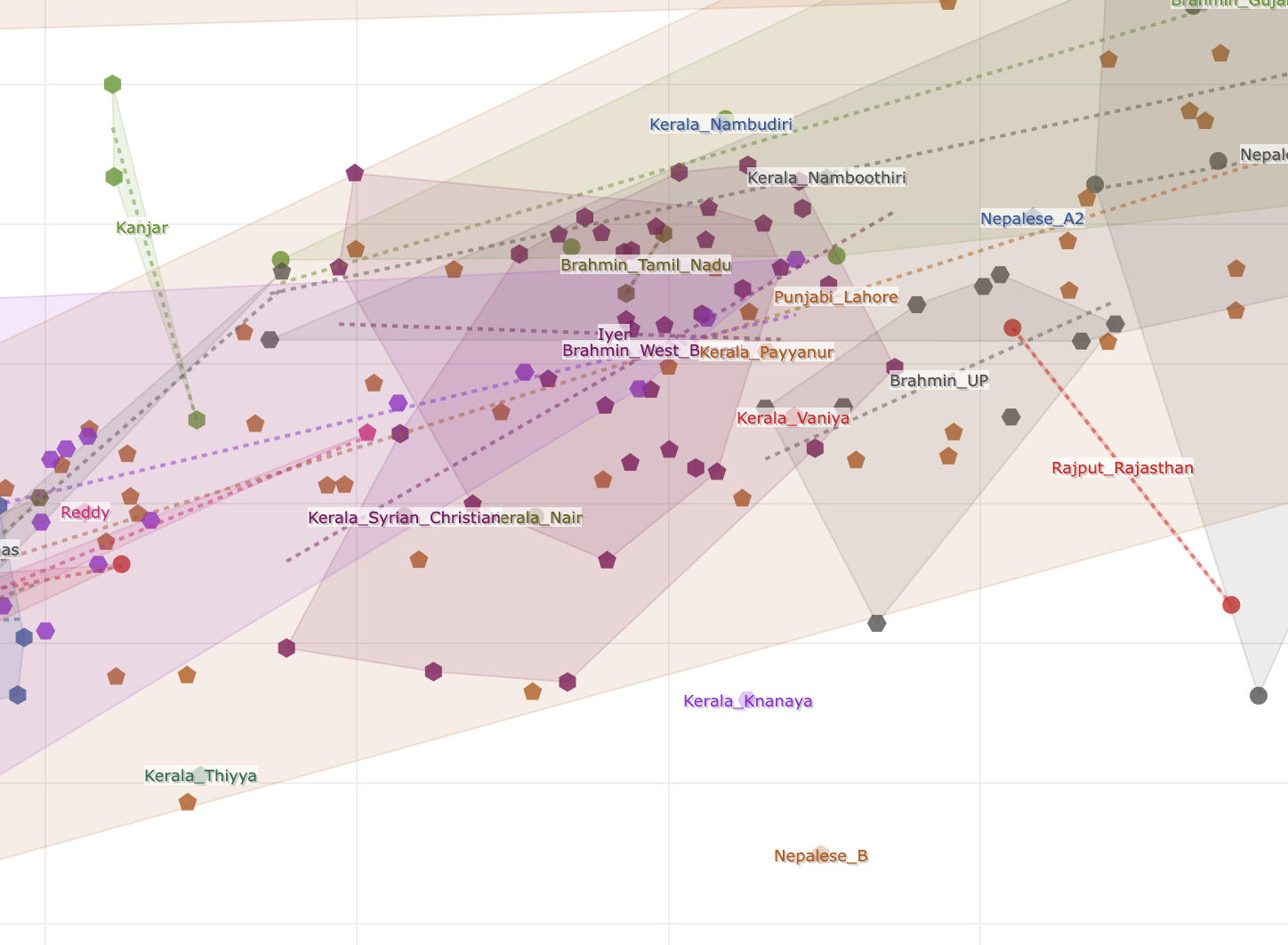
Below is a custom-PCA that shows us the genetic variation in modern Indo-Iranians.


Let us make some observations. The left-right PC1 cline shows the biggest variation, which is Basal East Eurasian vs. West Eurasian ancestry. To the far left, we have AASI rich tribals such as Birhor, Paniya and Irula, and to the far right, we have Iranian Jews who have no AASI ancestry.


As we head to the right, we see South Indian OBCs and farming castes, as well as some North Indian Chamars, Punjabi Christians, Marathas and Yadavas clustering together. These groups have little Steppe ancestry and are mostly a 50:50 mix of Iranian Farmer:AASI. It is interesting to see Christians from Punjab cluster with South Indian OBCs and Chamars, this would make sense since they might be converts from the lower castes. A note must be made here: it's unlikely the Yadavs here are from North India, as the ones from North India have 15-20% Steppe ancestry, rather they maybe Gollas from the Telugu states. 

The Marathas in the G25 dataset are from Karnataka so only have 5% Steppe ancestry. It's quite possible that 96 Kulin Maratha have a different genetic profile. Moving further to the right, we see some Reddys, Velamas and a lot of Punjabi Lahore samples. Now, the Reddys are a dominant land-owning caste of the Telugu-speaking lands and while traditionally considered as Shudra, they were warriors who ruled a kingdom

In fact, for any non-Indian reading this post, it must be ascertained that Shudra did not really represent a "low-caste" historically, but only the caste of farmers and pastoralists, who occassionally would also become warriors. The original Vaishya caste had this function in Vedic times: that of pastoralists and farmers, hence why they were literally called the vish, or the people. This function got transfered to the Shudras long before Christ was born, which is why the Manusmriti talks about Shudra Kings ruling in different parts of India. 

Moving on, what's interesting is the diversity in the Punjabi_Lahore cluster. A lot of the people in it cluster with South Indians, and a lot are on the other extreme, clustering with Punjabis Jats, Kamboj and Khatris. This tells us that the researchers who sampled this did not take caste into account, so Lahori Punjabis from Pakistan who are low caste got included in a label with Lahori Punjabis from Pakistan who are Jats, Gujjars etc. 

Further right, we see a cluster that has most Brahmins, a few Keralites, many Nepalese and a couple of Rajputs. This is the generic "UC" or Upper Caste cluster. By the way, ignore the Uttar Pradesh Brahmin outliers and Rajput outliers from this PCA. They are shifted towards Mongoloid Tibeto-Burmans, and this maybe because they're from Uttarakhand where the natives are mixed with Tibeto-Burmans, or it maybe a case of mislabelling the samples. The non-outlier Rajput from Rajasthan clusters with UP Brahmins. Regardless, we see that Bengali Brahmins, Tamil Brahmins, Keralite Brahmins, Rajputs, some Keralite middle castes such as Vaniya and Christian and many Nepali Brahmins cluster together. Many samples from Punjabi_Lahore can also be found here. 


Further right, we see the North-West Brahmin cluster, which is more Steppe/West Eurasian shifted than the generic UC cluster, and has Brahmins from Jammu, Himachal, Kashmir and Gujarat, clustering along with some Punjabi Hindus and NepaleseA (likely Nepali Brahmins).


To the right of this, we get the North West Indo-Pakistani cluster, which contains the most Steppe and Eurasian shifted groups in the subcontinent. Notice how the Rors and Kalash lie a little distinct from this cluster too. The Kalash do not have that much Steppe ancestry (25%) but they do have a lot of Siberian/Turanian ancestry from Bronze Age groups such as Aigryzhal_BA, and actually the Kalash are shifted towards them on the PCA.  This becomes more clear when we see a 3D PCA (the one posted here is 2D unfortunately). 

The main North-West subcontinental tribes such as Sindhis, Khatris, Jatt Sikhs, Jat Hindus, Kamboj and Pakistani Pashtuns cluster together. We can notice how most of the Jat_Hindus cluster have an overlapping cluster with the Rors, indicating many have similar ancestry; however, one of the Hindu Jats is an outlier and clusters with the less Steppe, more AASI shifted Northern Upper castes. This might indicate variation in Jat Hindus, but we might just have too little samples.

Yusufzai and Uthmankhel are Pashtuns from Pakistan, who are shifted to the Iranic cluster but still visibly in range of the NW Indo-Aryan one, thus indicating they have overlapping ancestry from both groups. Also, one can see me in this cluster too, plotted next to the Khatri:K56 sample. This is typical of my own ancestry as a NW Indo-Aryan (55:30:10:5, Indus:Steppe:AASI:BMAC). 


Now begins the Iranic side of Indo-Iranian, the other branch.  First, we come to the Eastern Iranic cluster. The Baloch are split up in 2, with BalochB must more Indo-Aryan shifted while BalochA cluster with the Brahui and one lone southward shifted Tajik. Notice the Brahui, a Dravidian speaking group from Pakistan that has ancestry very typical of Balochi Iranic speakers, perhaps a relic population from the Indus Valley? 

Tajiks are notably northern shifted, as they carry the highest Steppe MLBA ancestry in South-Central Asia, followed closely by Hindu Jats and Rors. Yaghnobi Tajiks, who still speak an Eastern Iranic tongue, have almost no AASI ancestry and hence are visibly separated from the rest. Tajiks from Hisor and Ayni generally have the highest East Asian ancestry in Tajikistan (upto 15%) and the lowest Steppe MLBA (30%). 

Finally, we come to the Western Iranian cluster, that contains Parsis, Lors, Zoroastrians, Persians and Kurds. Note how Parsis from Pakistan and India cluster with Western Iranians, this makes sense as they are 75% West Iranian, 25% Indo-Aryan in DNA. One will also notice how Iranians from Bandari are the closest to Parsis, this also makes sense as they have the highest Indian ancestry in Iran. Bandari in Iranian literally means "from a port" and these are Iranians from the Gulf who obviously had trade contacts with India and Africa (which is also why they carry around 3% Bantu ancestry). By the way, Bandar in Hindi would be 'Bandhdvar', so one can now see the etymology clearly, meaning 'closed door' 


Maratha & Chitpavans

Marathas seem to have a lot of variation in their Andronovo and AASI ranges. Perhaps this is a confirmation of the fact the modern Maratha c...